Showing posts with label Paul Smith. Show all posts

This is Going to Hurt: Secret Diaries of a Junior Doctor by Adam Kay


read by Adam Kay

Adam Kay has given so many interviews and there have been so many prominent reviews of This is Goingto Hurt that a lot of the best jokes and funny episodes have already been aired many times. But don’t let that put you off. Medical students have always told tall tales and usually have a swollen list of anecdotes about their colleagues and patients. Medical black humour is as old as the medical profession itself and the tooth-pulling, grave-robbing, elixir-pushing mountebanks who preceded them. 

At book signings (at which, alas, full recommended price is usually a given), apparently, many a copy of This is Going to Hurt is destined for the (at the time of going to press, as the saying goes) Secretary of State for Health (and Social Care) Jeremy Hunt (he of a privatised NHS fame). Kay has famously shrugged off his medical calling and opted instead for writing and comedy. And if you listen to this audiobook you will find out precisely why.

The tall tales are good (especially as they are narrated by the author). The funny things people do to themselves are, well, excruciatingly funny also. However, the repeated sacrifices of a doctor’s life are saddening and the consequences of underfunding, under resourcing and overworking are chastening.

In the end, despite the jokes that are somehow not jokes at all (‘home delivery is for pizzas not babies’) and the jokes that are, one hopes, jokes (‘the undergraduate learning centre’ being known as the ‘early learning centre’), this is a deepfelt cry for attention from a professional who couldn’t carry on given the shameful and shocking demands on junior doctors of a health service in crisis. 

Shame on all of us to allow this to be.

* * * * *
© copyright 2018 AudioBooksReview. All rights reserved.


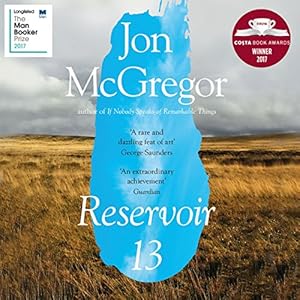
Reservoir 13 by Jon McGregor


read by Matt Bates

A Guardian Book of the Year; a Financial Times Book of the Year; a TLS Book of the Year; an Observer Book of the Year; a Daily Telegraph Book of the Year; winner of the 2017 Costa Novel Award; longlisted for the Man Booker Prize; shortlisted for the Goldsmiths Prize.

This story of the lives haunted by one family’s tragic loss of a teenaged child in a rural English village has been praised to the skies by literary critics, popular critics and the general reader. The books is structured so that each paragraph is a month, each chapter a year, with one extra paragraph at year’s end. For thirteen years. It is slow, thoughtful, poetic. And anyone seeking a resolution to the disappearance will be disappointed. There is none. Which is, perhaps, the point of the whole exercise: often life just goes on. Things might fall apart for a few, but for everyone else life carries on in its infinite sameness.

Perhaps this is Beckett without the humour, Joyce without the wit. Perhaps there is a touch of the emperor’s new clothes: how can the cognoscenti be wrong, with their metropolitan nostalgia for a piece of Albion idyll? Have any critics given less than fulsome praise?

Narrator Matt Bates produces a great performance, but the nuances are better appreciated on the page. It is rather a flat read: uneventful, unremarkable. Impressed by all the acclaim, I am sure many readers and listeners will come away from Reservoir 13 thinking: ‘what is it I missed?’ Many a Christmas present will be left half read and forgotten.

Make up your own mind. 

* * *
© copyright 2018 AudioBooksReview. All rights reserved.


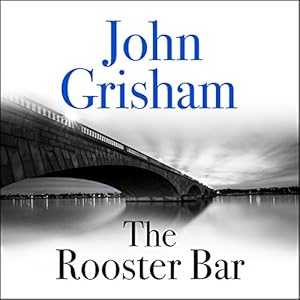
The Rooster Bar by John Grisham

read by Ari Fliakos

Grisham is a long-time favourite of AudioBooksReview. He has the enviable talent of whetting the appetite, getting the juices flowing and then delivering something arguably unsubstantial but generally satisfying to consume and mull over in retrospect.

Characterisation might be a little thin (two of the protagonists of The Rooster Bar, Mark Frazier and Todd Lucero, are at times indistinguishable: something perhaps substantiated by the bedmate they share, prosecutor Hadley Caviness), but the story carries you along and, well, you just have to know how it all ends up. So many books fail in their initial hooks and there are a fair few that, despite rewinding and restarting, your reviewer has never heard further than the opening twenty minutes.
The Rooster Bar fulfils the Grisham promise.

Inspired by an article in American magazine The Atlantic, Grisham’s new book examines the for-profit legal education industry. These new establishments, deemed educational and named ‘universities’, are part of a criminal cohort now plying their cynical trade in England too. In England, annual fees of just under £10,000 are charged by former polytechnics and greedy new colleges, just like older varsities, but which cannot be said to offer anything like a comparable education or qualification.

In The Rooster Bar, Mark Frazier, Todd Lucero and Zola Maal are third-year law students, deep in debt, facing their final term at Foggy Bottom Law School in Washington, DC: a prestigious location, but more dedicated to profit than to learning. Friend and classmate Gordy Tanner has convinced himself of the educational conspiracy whereby law schools admit unqualified students so as to profit from their student loans. Moreover, Foggy Bottom’s owner, a Wall Street lawyer, also has links to one of the banks that specialises in lending to students. Gordy’s discovery tips the balance of his frayed nerves and he jumps off the Arlington Memorial Bridge.

The students, routinely harassed by the banks lending them the money to study, and troubled by their friend’s suicide, eventually decide that enough is enough. They drop out of classes, assume new identities and, with the Rooster Bar as their business address, trawl the lower courts, ambulance chasing, picking up desperate clients for traffic violations and the like so they can practise law without a licence a felony, they reassure themselves, rather than a misdemeanour, but lucrative work and they are learning law on the job, so to speak.

Of course, it all goes right until it doesn’t, with a few unhappy clients and their own creditors starting to close in. A class action, with thousands of complainants who apparently don’t need to be verified to share in a multi-million dollar out-of-court settlement, is the climactic clincher: debts wiped out, money in the bank (lots), early retirement in a warm place with new identities. What could go wrong?

Grisham’s simple morality tales of Davids and Goliaths rarely fail to satisfy. The protagonists might be a trifle two dimensional, but the yarns are entertaining yarns and feed the imagination with plenty of the magical ‘what ifs’ of popular fiction.

Can’t wait for next year’s.

* * * *
© copyright 2018 AudioBooksReview. All rights reserved.


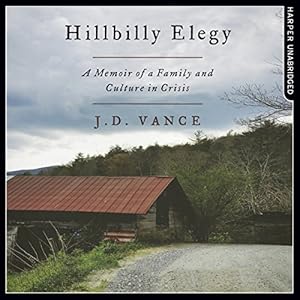
Hillbilly Elegy by J. D. Vance

read by J. D. Vance
Anyone looking for an explanation of why poor white working-class Americans voted for Donald Trump in the 2016 US election will be disappointed by J. D. Vance’s bestselling autobiography. It is a classic American rags to riches tale of social opposites and is slated for Hollywood endorsement in the glory days of the Trump first term. 

But it does not explain how the American poor came to believe Trump’s promises or could possible identify with a man who inherited his wealth from his father, avoided conscription to the war in Vietnam and allegedly employed cruel and bullying tactics to harass rent-controlled tenants from a building he wanted to redevelop overlooking New York’s Central Park.

Vance, a Yale law school-educated investment manager, who has espoused Republican values with a vengeance, rather like the alcoholic who becomes a proselytising teetotaller, gives us his special take on the family and people he has left far behind, the so-called hillbillies of the Appalachian Mountains, and charts the highs and lows of his early life and the lives of his absent father and his substance-abusing mother. His childhood and adolescence are startlingly similar to those of that Californian hillbilly the late Charlie Manson. Vance credits his ability to move away from his roots to the relative stability of his grandmother Mamaw, and a certain amount of luck.

With his wife Usha, Vance is now on the other side of the tracks, and his antipathy and disdain for the so-called ‘Welfare Queens’, the recipients of welfare who have been the enemies of Republicans since the days of Ronald Reagan, is uncompromising. Of those on welfare, he recalls, ‘I could never understand why our lives felt like a struggle while those living off government largesse enjoyed trinkets that I only dreamed about.’

Vance himself was helped first (and probably most) by joining the marines, in a military much less class based than the British, and then by government loans. From the comfort of his now moneyed life, Vance is able to share the uncomprehending anger he has instinctively felt in his new life, particularly with regard to his wife, details of whose background he chooses not to share with his readers, and episodes such as when he spits out Italian sparkling water at a formal dinner, thinking he had been given, possibly unkindly, something unspeakable to drink.

It is not difficult to understand quite why this book has become so garlanded: it seems to confirm everyone’s prejudices, left and right, liberal and conservative. And the sad fact is that little will change in the USA, with the rich getting more and the poor losing more, until everything comes to a breaking point and dissatisfaction with the status quo leads to riot and revolution: Manson’s oh so prescient ‘Helter Skelter’.

* * *
© copyright 2018 AudioBooksReview. All rights reserved.


Camino Island by John Grisham

read by January LaVoy

Grisham can usually be relied upon to deliver the goods: instantly fascinating setting; troubled yet sympathetic protagonist; nasty (generally corporate) villain; unforeseen plot twist; satisfying dénouement. He is a consummate storyteller, even if the prose can be undistinguished. He certainly keeps the listener wanting to learn more (so many audiobooks fall flat within minutes).

Unfortunately, with Camino Island, the ‘Author’s Note’ reveals Grisham’s flaw: ‘I learned with my first novel that writing books is far easier than selling them … I know nothing about the retail side of the business’. He should really stick to what he demonstrably knows a great deal about: the law. In Camino Island, plot and characters really don’t convince. For this listener, his familiarity with academics, university libraries, rare books and even fellow novelists doesn’t ring quite  true.

Grisham’s characters often have a ton of good fortune. Rare book dealer Bruce Cable is no exception. He starts out with money and then discovers that his late father had an enviable library of, mainly American, mainly twentieth-century, first editions:  items easy to overlook as just a collection of second-hand books and a great tax dodge/money laundering vehicle. He buys a bookshop in a tourist paradise and makes a huge success of things: selling books, seducing authors on book signing tours, adding to his collection of rare modern editions, getting for a song one of the best old houses on the island and partnering a beautiful furniture dealer, an expert in French antiques. Everything is so perfect you want to scream. But that, of course, is Grisham’s art. And his charm.

The theft of F. Scott Fitzgerald’s manuscripts from Princeton University. And Bruce Cable’s inveigling into his deceptions of former English  professor cum novelist Mercer Mann, who has been planted on Camino Island by private investigator Donna Watson aka Elaine Shelby, the agent tracking down the priceless masterpieces … is sheer hokum. One comes away from Camino Island reeling off the manifold gaping holes in the plot. But Grisham manages, every pothole notwithstanding, to entertain until the very last word in the book.

 * * * * 
© copyright 2017 AudioBooksReview. All rights reserved.


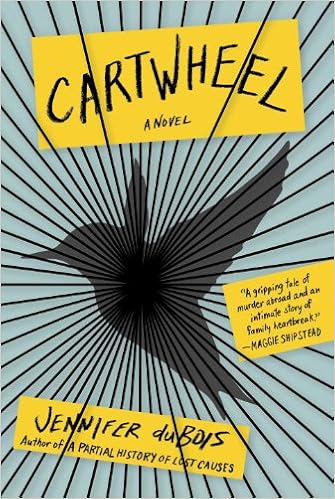
Cartwheel by Jennifer duBois

Read by Emily Rankin


Jennifer duBois showed her prodigious talent in her first novel A Partial History of Lost Causes (not published as an audiobook in the United Kingdom), making one think of Donna Tartt, with her mesmerising prose. And Cartwheel does have a tenuous connection with Tartt’s monumental masterpiece The Secret History, centring as it does on the murder of a university student.

Unashamedly inspired by the story of Amanda Knox (‘loosely’ inspired, duBois claims in a brief epilogue), the murder in question moves from Italy to Argentina, but the raw materials are all derived from Meredith Kercher, Amanda Knox and Raffaele Sollecito, including the cartwheel of the title, which Amanda Knox was widely reported to have performed at the police station after Meredith’s death (although Knox denied this, saying ‘I never did a cartwheel. I did do the splits ... once’). The novel is not exploitative of the Knoxes and the Kerchers very real traumas and grief. The events in Perugia are simply the spur that pricked duBois’s unequalled talent for place, time, character, motivation, voice, consequences. Lily Hayes is not Amanda Knox and Katy Kellers is not Meredith Kercher. But all the unanswered questions of Perugia resurface in Cartwheel. And, in this exceptional book, many of the same doubts still linger.

Emily Rankin’s reading is seamless: not too tense or melodramatic: thoroughly engaged. And well worth a second or third listen. 

Haunting.

* * * * *
© copyright 2017 AudioBooksReview. All rights reserved.


John Wyndham: BBC Radio Drama Collection

Six Full Cast Classic BBC Radio Dramatisations


Lightly dismissed as ‘middle-class catastrophes’ and ‘cosy disasters’, John Wyndham’s novels, written chiefly in the 1950s and 1960s, are still chillingly shocking and disturbing dramas that make the reader question what we, as humans, are doing to our planet and, crucially, whether we are alone in the vastness of those universes beyond our own.

The Day of the Triffids, The Kraken Wakes and The Midwich Cuckoos are probably read less now than at any time in their publishing history (although it is interesting to see that H. G. Wells’ War of the Worlds is currently on one GCSE English Literature syllabus). Wyndham’s novels are, perhaps, ‘an easy read’, but much of their appeal is the way he turns upside down a tranquil world where the last thing on people’s minds is the thought that anything could prevent life from continuing as it had done since the turmoil and upheaval of the protracted end to the Second World War.

These BBC radio dramatisations are enjoyable first of all for the retelling of the novels, but then for the insight we are given into the radio writers, actors, producers and audiences at the time of the original broadcasts. The accents of the lead actors in The Day of the Triffids, for example – Gary Watson, who made his name in countless television dramas, and Barbara Shelley, famous for her Hammer Film roles (playing Bill Masen and Josella Playton)  –  sound to modern ears frightfully cut glass. Few actors today would even attempt such accents, but they are perfect for this post-war apocalypse (dramatised by BBC radio drama pioneer Giles Cooper and first broadcast in 1968). But that is part of the appeal of this collection.

A fascinating feature of The Day of the Triffids is that the transcriptions are episodes shortened for sale to foreign broadcasters, most of whom needed time for commercials. Anything deemed ‘inappropriate’ for a overseas audience was routinely cut. Twelve minutes of the deleted material is included here on the final CD of Triffids.

Of the other broadcasts, The Kraken Wakes, from 1998, is rather prescient in the light of the rise in sea levels through global warming. As the Thames breaks its banks and then submerges the Houses of Parliament, the listener is left realising that this modern-day Noah’s Flood is perhaps not so far-fetched.

Chocky (from 1998) is fascinating, as a schoolboy communicates with an entity from the future, a ‘girl’ (although there is only one gender on her planet) who is trying to impart the secrets of an energy source that will save the Earth from eventual destruction. Fables of Nikola Tesla’s inventions and conspiracy theories that the petro-chemical industry in the USA tried to interfere with work on the electric car all spring to mind as twelve-year-old Matthew is kidnapped, hypnotised and threatened when it is revealed that he may be the conduit for a new science emanating from a different world. The dramatisation is gripping and absorbing and John Constable’s script is excellent, building as it does to its inevitable denouement. John Tydeman produced a version for BBC Radio in 1967; it would be great to be able to hear that version too.

Perhaps the best of the six here is Dan Rebellato’s 2003 production of The Midwich Cuckoos (again, there was an earlier version by William Ingram). Bill Nighy and Sarah Parish are perfect as Richard and Janet, who are fortunate enough to stay away from the village of Midwich on the night when all the women, young and old, married and single, find themselves ‘with child’. Controversial for its time, and disturbing still today, issues of abortion, eugenics and egg-sharing are not far from the surface of this intriguing and disturbing mystery, displaying just how current Wyndham still is in the second decade of the twenty-first century.


Essential.  
* * * * * 
© copyright 2017 AudioBooksReview. All rights reserved.

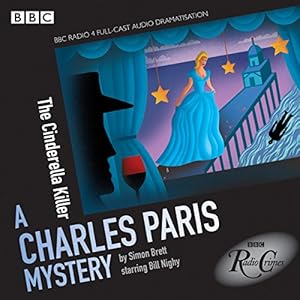
The Cinderella Killer by Simon Brett

Dramatised by Jeremy Front:  BBC Radio 4 Full Cast Recording

If you have never treated yourself to one of Simon Brett’s Charles Paris creations you have missed out on a good many hours of sheer pleasure. Bill Nighy is perfect as actor Charles Paris, perhaps just beyond his best days, struggling with ex-wife Frances (Suzanne Burden) and the always-busy-with-more-famous-clients agent Maurice (Jon Glover).  ‘Hi-ho, the glamorous life!’ as Stephen Sondheim famously puts it in ‘A Little Night Music’.

Whether it is in the television or radio studio, but much more probably in provincial rep., Paris always seems to find himself in the middle of intrigue and murder, often mirroring the plot of the plays in which he manages to land a part.

In The Cinderella Killer, Paris tries his hand at provincial panto, having suffered as a department store Santa the nastiness of children grabbing his beard, poking his stomach and micturating as they sit on his lap. Surely, Maurice can find something more befitting his prodigious thespian talents and lengthy résumé.

But panto is better than nothing and Charles is soon glad-handing old mates and finding drinking buddies with new best friends. Meanwhile, things are going better with his ex and he is even making the late-night train back to town rather than staying in off-season lodgings with a dodgy seaside landlady. However,  murder and intrigue are never far away. Actors are an unforgiving lot, and what with stage-door groupies and an American TV actor with a questionable history, Kensington Gore (out of place at panto time, surely) soon turns into the real thing.

This is BBC radio at its best: two hours of drama, suspense and good old dry wit worth visiting and revisiting many a time and oft. Why Bill Nighy hasn’t been knighted is a mystery. Likewise, Simon Brett, a comic genius up there with Waugh and Wodehouse.

Unsurpassed. (Until the next one.)

* * * * *
© copyright 2017 AudioBooksReview. All rights reserved.

Dracula by Bram Stoker

Adapted and dramatised by Liz Lochhead, with Ellie Beaven, Rebecca Callard, Tom Hiddleston and David Suchet

There is no denying the lasting power of Bram Stoker’s tale of the evil that is Count Dracula. The Count’s plan to move from his homeland in Transylvania to England and to become a member of Victorian English aristocracy is familiar through film and television and displays, perhaps, the cultural gulf between Eastern Europe and Western Europe still evident today.

Like many literary classics, few people in the twenty-first century have the time and patience to read the original, preferring to digest others’ versions and adaptations. Appearing in print in 1897, Stoker’s prose is not the greatest writing of the time from the pen of an Irishman, but it is better than that of some more contemporary authors who write tales of the Un-dead (Stoker’s original title for the novel).

Noteworthy is the epistolary method of story-telling, using letters and diaries, which works exceptionally well given the story-line: Jonathan Harker is confined in the Count’s castle and, unable to send or receive letters, keeps a written account of his journey and of his time with the Count. The exchange of letters between the other characters, ships’ logs and newspaper clippings drive the story on and perhaps reveal more about the protagonists’ inner thoughts than might more conventional writing.

It also make Dracula perfect for radio, and this BBC World Service dramatisation, judiciously abridged and adapted for the medium, is a rare triumph and well worth two hours of anyone’s time. Stereo makes the whole thing come very much alive (if that isn’t too great an irony) and the performances are exemplary. David Suchet’s Dracula is spine-chilling, mixing aristocratic disdain with psychopathic superciliousness. Ellie Beaven (Mina) and Rebecca Callard (Lucy) provide just the right amount of flirtatiousness and suppressed eroticism, and Tom Hiddleston (Jonathan Harker) is perfect as the straight-laced and hugely naive country solicitor.

Whilst the lengthy original certainly repays perseverance, the BBC’s Dracula provides an intense and very palpable sense of menace in the figure of one of the first stalkers in literature and his merciless pursuit of victims to feed his insatiable appetites.

Superb.

* * * * *

© copyright 2016 AudioBooksReview. All rights reserved.

Buy Dracula

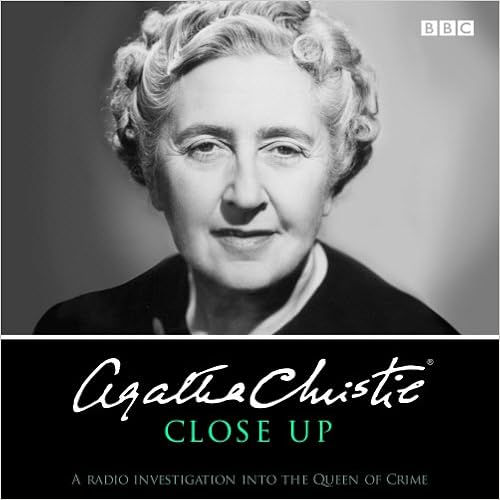
Agatha Christie, Close-Up

Four BBC Radio documentaries about the Queen of Crime

Queen of Crime, Agatha Christie, was a curiously private person and, despite living until 1976, very few recordings of her discussing her work have survived: she was from a very different time indeed.

In this remarkable audiobook, the BBC has brought together four radio programmes about Christie the woman, the writer and the phenomenon. For she captivated and fascinated a loyal readership from the very first detective novel, The Mysterious Affair at Styles, which she published in 1920, right up to the present day, almost one hundred years later.

The characters she created, including Hercule Poirot and Miss Marple, to name just two, and her stories and plays, are just as much in demand today as they ever were: still in print, but also on the small and silver screens, and still regularly in amateur and professional theatre companies in the provinces and in the West End. She really is a truly singular literary phenomenon.

Because so little exists of recordings of Christie, some of the material in these programmes is heard more than once. But that matters not a jot. Each programme tells a different part of her extraordinary story, with contributions from, amongst many others, Richard Attenborough, Allen Lane, Marghanita Laski, Cliff Michelmore, A. L. Rowse and Nigel Stock. The programmes range in date from 1955 (for the Light Programme) to 1975 and 1982, with a new contribution for Radio 4 Extra produced by Peter Reed in 2015/16, and will delight any Christie devotee, of which there are many all over the world.

A perfect Christmas gift for aficionados of Agatha Christie, one interesting feature to note is the changing voice of the BBC – or rather the changing accent of the BBC. Vanished now is received pronunciation, or RP –  the educated voice of the privileged Home counties. How differently people speak today compared with the 1950s, 60s and 70s: even actors, broadcasters and other professionals. Does no one speak that way any more? And what, one wonders, will things be like in another fifty years?

Indispensable.

* * * * *

© copyright 2016 AudioBooksReview. All rights reserved.
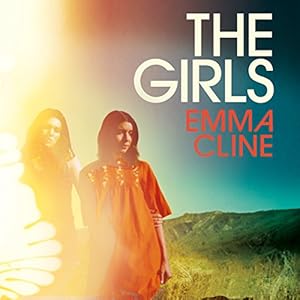
The Girls by Emma Cline

read by Cady McClain

The Girls has achieved a startling and almost unprecedented amount of attention in all media for its author Emma Cline – as well as an enviable advance, which, judging from the print and radio reviews that have so far appeared, should pay royally for the publishers’ three-book deal. It also was pirated online on publication day, which might be a further measure of its notoriety and success.

With the Manson murders now almost fifty years ago (1969) and the recent release on parole of Leslie Van Houten, one of the many convicted of complicity in the senseless and brutal Tate–La Bianca murders, much can only be expected in the next few years to recount the goings-on of the Family and Charlie Manson at Spahn Ranch, in the Hollywood Hills. Fire consumed the ranch fairly soon after the Manson trials, which might otherwise have been turned into a tourist destination. Many of those convicted are dead. Manson enjoys a cultish following, complete with website selling t shirts, music and ‘memorabilia’. The late Vincent Bugliosi’s account of his part in bringing Manson to justice remains a fascinating record of the LAPD at the time and of the sixties judicial system in the USA. It is a masterpiece in its own right and repays a close listen in the outstanding audiobook version read by Scott Brick.

So the only question remains might be why it took so long to turn the stories, especially the stories of Manson’s loyal ‘girls’ into fiction. There have been a number of mainly ghost-written accounts of life at Spahn by a few of the people who hung out there, including some of those convicted and imprisoned. But The Girls is arguably the first fully to exploit the possibilities. 

And although the book makes for a compelling listen, I can’t quite see what all the fuss is about. As YA fiction it ticks all those stereotypical boxes. But haven’t others done this before? And better? Robin Wasserman’s Girls on Fire, for example, is more convincing, scarier, more visceral. Alison Umminger’s My Favourite Manson Girl is, I think, pithier and better written.

I hesitate over the creation of ‘Russell’ – the Charles Manson character. ‘Russell’ lacks the common quasi-friendly feeling of a Charles or a Charlie (think Chaplin and his girls). And so much is significant in the hint that Charlie was Christ, the son of God, of Man – Man’s Son – that ‘Russell’ just doesn’t even slightly hint at. I know this is fiction. But the cult idea and Russell’s musical ambitions, his way of making the most of anyone with the slightest influence or connection with fame, stardom and its inherent wealth are well exploited in The Girls. But, despite his depiction as a guitarist and his deep yearning for a recording contract, where is the music in the book? Where are the racial elements, the Bible, the obsession with others musicians’ lyrics? What is missing is some kind of helter skelter.

Cline’s prose has been praised. And there are fine passages. The fourteen-year-old Evie Boyd, with all her adolescent angst and desperation is good. But the middle-aged Evie is no monster: her links with the murders are third hand, her love for Susanna unconvincing.

What we were led to believe was an American masterpiece is oddly unsatisfying and ultimately a disappointment. There is a fine book waiting to burst out from the raw bones of this novel, but I believe a good editor should have told the author to go back and make more of some great material. It could have been a work that would have stayed the test of time. As it is, I fear it will be easily eclipsed by all those other authors looking to build on the allure of a cult and the ghastly reverberations of a society that produced Charles Manson’s Family.

* *

© copyright 2016 AudioBooksReview. All rights reserved.
Buy The Girls

A Dark Inheritance by Chris d’Lacey

read by Raphael Corkhill

UFiles #1: A Dark Inheritance (Unicorne Files, Book 1)

A Dark Inheritance is the first in a projected series of young adult ‘fantastic fiction’ books from Chris d’Lacey, the author of seven novels under the title The Last Dragon Chronicles.

There is a lot to enjoy in the twists and complexities of the circumstances in which young Michael Malone finds himself following a chance cliff-top encounter with a suicidal husky. From an ordinary schoolboy, Michael is audaciously transformed into someone with supernatural abilities and joins UNICORNE, which appears to be a covert organisation involved in investigating strange and paranormal phenomena.

With a great dramatis personae  – Mom Darcy (placing the story in the USA, although much else feels decidedly English); younger sister, Josie, (aged ten, who both doesn’t play the violin and (in a parallel universe) is a virtuoso); prominent-cheekboned, au pair/ teacher/ martial artist Chantelle; goth schoolgirl Freya (who is dead and then undead); Amadeus Klimt, creepy head of the covert organisation UNICORNE; and, of course, Michael.

Much in the book demands a re-read because the shifts in the narrative make it difficult to know just what is true and then what is going on in an alternative reality. Central to the story is the disappearance of Michael’s father three years ago, and the first line of the story indicates that that is unquestionably what the plot is going to reveal: ‘One day before I began to wonder if my father was still alive.’ (Whether such syntax should be encouraged in a book for adolescents is another matter entirely.)

Nonetheless, I feel sure A Dark Inheritance and its successors will fill many a Christmas stocking, whether in paperback, on kindle, or in the fabulous audiobook narrated by Raphael Corkhill, who manages to bring all the characters to life (even the dead ones) and makes one want to listen through to the very end   – and then to wish for further adventures still. I hope we will hear a great deal more from this actor.

* * * *

© copyright 2014 AudioBooksReview. All rights reserved.
Buy A Dark Inheritance

Mindfield by William Deverell

read by Steve Scherf and Maggie Scherf

to come 


xxx

* * * *
© copyright 2014 AudioBooksReview. All rights reserved.
Buy Mindfield

The Silkworm by Robert Galbraith

read by Robert Glenister

Galbraith (Rowling) pulls it off once again in this pacy macabre thriller where we find out yet more about private detective Cormoran Strike and his complicated family relationships. Things develop also where his assistant Robin is concerned, with her appalling fiancé Matthew.

With literary satire on the agenda, and the plot revolving around an unpleasant collection of publishing types, it is clear that Rowling is settling a few scores from her painful rise to fame and fortune. 

Strike is asked by the wife of a controversial man of letters to locate her husband, Owen Quine, who has quite simply disappeared into London’s wilderness. A copy of what purports to be his latest work, Bombyx Mori, has been ‘leaked’ and it turns out to be like something from the pen of the Marquis de Sade, depicting cannibalism, rape, torture and necrophilia, its protagonist consumed, literally, by a cast of characters resembling many from Quine’s life and who he maintains are responsible for his ruined career.

The book is tantalising, fascinating and satisfying. And it makes a great listen, read as it is with skill and deft timing by Robert Glenister.

The only cavil would be the ponderous and pretentious epigraphs that lumber the chapter openings. Fine on the printed page, they are a self-conscious element of the style of the work, to be sure, but they make finding one’s way around the audiobook difficult and frustrating.

* * * *
© copyright 2014 AudioBooksReview. All rights reserved.
Buy The Silkworm

The Black Eyed Blonde by Benjamin Black

read by Dennis Boutsikaris

It is a fine and difficult line to tread between homage and parody when attempting the genre of the American private eye. Robert B. Parker has famously been here before Benjamin Black, first finishing Raymond Chandler’s final Philip Marlowe novel Poodle Springs and then writing Perchance to Dream, which takes off where The Big Sleep ends. Parker has his detractors, although both books succeed in large measure, but Benjamin Black [Man Booker Prize-winning John Banville] has had almost unanimous praise for The Black Eyed Blonde, which it is to be hoped will send the reader back to the wonderful prose Chandler created and sustained.

The plot is sharp, the characters well drawn, and the prose is full of wit and grace. It certainly starts promisingly:

‘I watched a woman at the corner of Cahuenga and Hollywood, waiting for the light to change. Long legs, a slim cream jacket with high shoulders, navy blue pencil skirt. She wore a hat, too, a skimpy affair that made it seem as if a small bird had alighted on the side of her hair and settled there happily. She looked left and right and left again – she must have been so good when she was a little girl.’

The observations, the simile, the implication that the long-legged woman might not be quite so ‘good’ as when she was a little girl, are all highly suggestive of Chandler’s style. And for the most part Black maintains this throughout, although some of the prose does sound a little self-conscious, and there are times when Black’s Marlowe thinks in ways Chandler’s Marlowe never would (‘I stand at this window a lot, contemplating the world and its ways’). There are also far too many references to characters and situations in the Marlowe canon, like the numerous instances where gimlets are the drink of choice, just so that we know that Black has done his homework.

But the above does not detract from the tremendous pleasure that The Black Eyed Blonde provides. And it deserves more than a single listen or read. Ersatz Chandler is better than no Chandler at all, and there are very few who could do it as well as Black. Moreover, Dennis Boutsikaris is outstanding – and Chandler is so much better in American.

* * * *
© copyright 2014 AudioBooksReview. All rights reserved.
Buy The Black Eyed Blonde

King of the Mountains by Dan Possumato

read by Edoardo Camponeschi

Italian peasant hero Giuseppe Musolino, who in 1897 was falsely convicted of a heinous crime and at his trial vowed to escape to wreak vengeance for such a travesty of justice, is rightly famous in his local Calabria, but his tale has not been told before in English. His did break out of gaol, and, true to his word, sought out those who had done him such wrong. Musolino succeeded in his vendetta and eluded capture through luck, bravado and cunning and with the support and cooperation of the local people, to whom he became the Robin Hood of Italy. It is a fascinating tale.

This well-researched and captivatingly written account by Dan Possumato (a distant descendant of Musolino) brings a great character to life.  King of the Mountains is an exciting story, full of  local colour, that is entertainingly read by Edoardo Camponeschi and makes an excellent audiobook with plenty of derring-do and drama.  

* * * *
© copyright 2014 AudioBooksReview. All rights reserved.
Buy King of the Mountains

Look Who’s Back by Timur Vermes

read by Julian Rhind-Tutt

The American-educated son of a wealthy German publisher once crowed proudly to me of the magnificent wide roads and wonderful autobahns the Fuhrer had been responsible for, as we toured the sights of Berlin. But his father’s staff looked away and blankly refused to comment when in passing I mentioned a fascinating BBC radio programme about Hitler’s relatives, whom it was suggested he might have visited in England before the outbreak of the First World War. Hitler was simply not a subject for conversation for ordinary Germans.

Which might go some way to explaining the reception Timur Vermes’s novel Look Who’s Back seems to have had when it was published in German in 2012 under the title Er ist wieder da. Hitler has for so long been taboo in Germany and his writings banned (even though they are so vile that readers hardly need to be protected from what successfully condemns itself). But can it really be that German readers are so ignorant of the facts of the Third Reich that at the end of Look Who’s Back Vermes has to provide potted histories of the main players in the Nazi hierarchy? In the UK there are television channels that provide little more than documentaries on Hitler, Nazism and the Second World War.

So perhaps the German-speaking world was ripe for a satire on the modern world through the simple conceit of Hitler reappearing almost seventy years after his death and continuing with his deluded rants. And there is some humour in the idea that Hitler is taken to be a clever mimic who takes his method acting to the point where no one can question him again as to his true name, age and identity. And as a television and internet ‘comedian’, the Rumpelstiltskin dictator, like a modern-day Thersites, is thus allowed to comment on the present day and interrogate twenty-first century Germany and its immigrant workers, handies’ and computers, modern architecture, fast food, liberated women, uncensored newspapers, non-Gothic typefaces, Americanisms and pooper scoopers.

The translation is excellent and the performance by Julian Rhind-Tutt exemplary. But the whole idea falls limp and flat: the book is simply not very funny and not for that matter particularly satirical. The true irony is that Hitler wouldn’t for a minute suffer the foolish and deluded television performers and producers, especially as we are led to believe that he has not mellowed at all during his absence. Perhaps Vermes is trying to tell us that we have become so distracted by celebrity and trivia that we wouldn’t notice if another rightwing movement became popular again, and that we flatter ourselves at our peril that modern culture is too sophisticated to be hoodwinked once more. Perhaps.

Look Who’s Back remains, when all is said, a cultural oddity, with a nice piece of artwork on its cover.
  
* * *
© copyright 2014 AudioBooksReview. All rights reserved.
Buy Look Who’s Back

The Resistance Man by Martin Walker

read by Peter Noble

Rural France might well appear to outsiders and tourists to be something of an idyll, but chief of police Bruno’s life is far from tranquil. The delicious compensations of wonderful food, good wine, faithful canine, fine horses to ride, and a choice of beautiful women can always help matters, but political intrigue, brutal murder and uncompromising ambition appear increasingly less welcome but controlling factors in Bruno’s complicated life.

First there is the (natural) death of an elderly resistance hero and the appearance of some old bank notes that might have come from a famous Second World War train heist, when millions of French Francs disappeared from under the noses of the occupying Germans. Then, the retired former head of Britain’s Joint Intelligence Committee has his house burgled, losing antiques and wine to thieves who have been targeting empty houses in the region, getting away with furniture and art that is strongly in demand on the other side of the English Channel.

One particular burglary leads to grisly murder, with the victim’s lover, a theatre director, charming Bruno’s friends, despite being the prime suspect. A further burglary, this time involving Jacqueline, a long-term political activist and writer, who is revealing the strength of the French reliance on the USA for their ‘independent’ nuclear defence, brings back old flame Isabelle to St Denis.

There is always a lot going on in Martin Walker’s novels – and tragic revelations regarding Bruno’s deep need to become a father and raise a family to make complete his otherwise rewarding existence make this a most poignant listen – brilliant and compelling.

Definitely one for the road.

* * * *
© copyright 2014 AudioBooksReview. All rights reserved.
Buy The Resistance Man