Showing posts with label AudioBooksReview. Show all posts

Philip Odell: Lady in a Fog by Lester Powell


BBC Radio Full-Cast Drama

Writer Lester Powell is a part of radio history. His output was prolific, with more than sixty plays and serials to his name broadcast from just after the Second World War in 1946 until the 1980s. Most, alas are lost, never to be heard again.
Powell started writing radio adaptations of famous novels and short stories that went out on the BBC Light Programme, including some of G. K. Chesterton’s Father Brown detective stories. 
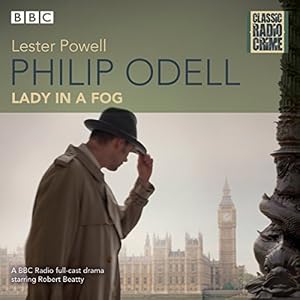
The detective genre was always popular on radio, just as police procedurals are on today’s television. Listeners to Radio 4 and Radio 4 Extra will know Francis Durbridge’s Paul Temple programmes, but some younger listeners will not be familiar with Lester Powell’s detective Philip Odell, the Irish sleuth who starred in seven radio serials, several novels and a feature film. Powell said that he had Raymond Chandler’s Philip Marlowe in mind when he created Odell, and there is much of Marlowe in Powell’s tough and dogged but fair detective played by Canadian actor Robert Beatty. His sidekick (and lover) Heather McMara was played by a number of actresses, including Brenda Bruce, Joy Shelton, Joyce Heron, Diana Olsson and Sheila Manahan.

Lady in a Fog was the first story to feature Odell and McMara and was broadcast in eight instalments in 1947, possibly in live transmissions, because the Lady in a Fog in the CDs under review is a second production, this time recorded for posterity, staged in 1958. Only one other recording of the Odell stories is said to exist.

In Lady in a Fog, Odell is on his way home to Ireland, but the flight is delayed because of a heavy London fog. He calls on Heather McMara only to learn that Heather’s brother has just been found drowned in the Thames. So starts Odell’s investigation and his run-ins with the police in the shape of Inspector Rigby, who thinks Odell might well be their best suspect when more murders start to turn up.
It would be interesting to be able to compare the 1947 and 1958 broadcasts, but that of course is impossible. Are the 1958 actors deliberately stressing the huge class differences in the protagonists that would have been evident in the 1940s? Or were they still there a decade later? It is always slightly shocking just how cut glass the accents are of some of the actors in ‘classic’ BBC drama from the middle of the twentieth century. But that too is often the appeal of these recordings.

It is probably pointless to try to summarise the plot, which follows a Marlowesque trail of low-life and patrician criminals, interfering police, the odd red herring, some romance. Odell never makes it back to Dublin but is set on his career as a private investigator in London.

There is much to enjoy in this four-hour, eight-part serial, with performances from a large cast of BBC Drama Repertory Company stalwart’s including Mary Wimbush, James Thomason, John Bennett, Jeffrey Segal, June Tobin, David March and Trevor Martin.

Peerless.

* * * * *
© copyright 2018 AudioBooksReview. All rights reserved.

Buy Lady in a Fog

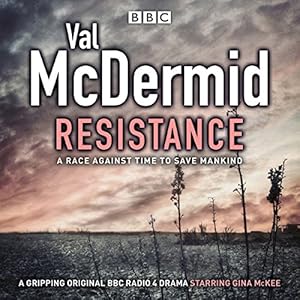
Resistance by Val McDermid


BBC Radio 4 Drama

Val McDermid, the Scottish crime writer, will need little introduction. McDermid started her writing career as a playwright, having had her first novel turned down by British publishers too numerous to mention (the old story). 

Her television work is well known to British audiences and Resistance is something of a treat for fans of radio drama. It is an original radio drama, commissioned, performed and broadcast by BBC Worldwide for Radio 4 starring Gina McKee. Developed as part of the Wellcome Trust and Radio 4’s Experimental Stories for Radio initiative an annual two-day workshop in which radio writers and producers work with researchers to develop dramas to pitch to Radio 4 Resistance certainly fulfils the Trust’s brief, which is ‘to ask big questions that are stimulated by biomedical research to reach people who aren’t usually interested in traditional science programmes’.

And it would be difficult to get much bigger than the apocalyptic devastation caused by factory-farmed meat that produces a pathogen resistant to all the antibiotics created since their discovery revolutionized medicine in the early days of the twentieth century.

Like many a good drama, Resistance is grounded in verisimilitude: resourceful tenacious reporter Zoë, who just happens to be vegetarian; rain-soaked English music festival; ‘pop-up’ food stalls selling poorly sourced sausages; 100,000 hungry festival-goers and musicians from all parts of the globe; festival organisers in denial. In the opening ten minutes we also hear the soundtrack from a television report on the current shameful lack of anti-microbials. It’s all slightly frenetic and, dare I say, predictable. But it is polished BBC radio drama, in three fifty-minute episodes, that makes the most of broadcast stereo and drives home the propagandists’ point. The outcome is inevitably bleak, reminiscent of John Wyndham’s The Kraken Wakes (McDermid adapted Kraken Wakes, updated to the present day, for BBC Radio 4 in May 2016). Humankind has little left; civilisation effectively eviscerated.

The cast is faultless, with Gina McKee as journalist Zoë, Jason Done as Jamie, Nitin Kundra as Sam, Angela Lonsdale as Lisa, Henry Devas as Baz and Ashley Margolis as Will: I hope such voices will continue to participate in audio drama, which rarely has budgets sufficient to reward such impressive talent.

Of course, the question remains: will humankind change its behaviour so that antibiotics can prevail? Or will we wipe out the human race through complacency and short-term greed? Probably we won’t know until it is much too late.  
* * * * *
© copyright 2018 AudioBooksReview. All rights reserved.

Buy Resistance

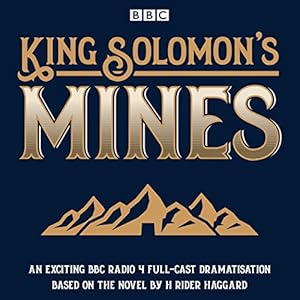
King Solomon’s Mines by H. Rider Haggard


BBC Radio Full-Cast Dramatisation

The 130 years since the first publication of H. Rider Haggard’s African novel of ‘treasure, war and wild adventure’ have seen such cultural and sociological change that it might be thought that his novels of the Victorian empire would have little to attract our attention. Famously written following the publication of Robert Louis Stevenson’s Treasure Island in 1885, when Haggard told his brother he could write something ‘at least as good’ (or ‘half as good’), King Solomon’s Mines was said to have taken the author six (or sixteen, depending on one’s source) weeks to finish. It was the start of Haggard’s lifelong and very lucrative career as a novelist. He wrote more than fifty books. She, the follow-up to King Solomon’s Mines, has been estimated to have sold a staggering 80 million copies.

Whilst reflecting a fair few of the prejudices and givens of nineteenth-century colonialism, Haggard does not entirely adopt the racism and misogyny of his era. Dedicated to ‘all the big boys and little boys who read it’ (girls read it too, but nineteenth-century parents often had firm views of what was suitable for boys and what was suitable for girls), King Solomon’s Mines represents the memoirs of the book’s protagonist, Allan Quatermain, as related to the author, so that Haggard’s own opinions are at arm’s length. The book can certainly be said to show admiration and respect for the peoples and cultures of Africa, and for its landscape, and there is deprecating irony in the taunt by Gagool concerning the white man’s insatiable desire for African diamonds:

The first shock of the slow and miserable end that awaited us was overpowering. We saw it all now; that fiend Gagool had planned this snare for us from the first. It would have been just the jest that her evil mind would have rejoiced in, the idea of the three white men slowly perishing of thirst and hunger in the company of the treasure they had coveted. Now I saw the point of that sneer of hers about eating and drinking the diamonds.


Kenneth Colley starred as Quatermaine in a 1990 BBC Radio 4 adaptation, which is well worth finding, if you can. It is surprising that the novel was not broadcast in the heyday of BBC radio (there is a forty-minute General Mills Radio Adventure Theater recording from 1977, which aired on the CBS Radio Network in the USA), but perhaps the many feature films satisfied the appetite for Haggard. It is the 2017 adaptation in the BBC recording under review here and it is gripping, entertaining and, in the appropriate places, moving BBC radio drama at its twenty-first century best.

It would be pointless to rehearse the plot. Just immerse yourself in one of England’s foremost Victorian adventure writers, whose imagination, fired by his five or so years in parts of what is now South Africa, transports you to an exotic and dangerous lost world.

The cast, led by Tim McInnery as Allan Quatermaine, David Sturzaker as Sir Henry Curtis and Simon Ludders as Captain John Good, features outstanding African actors Sope Dirisu as Umbopa, Femi Elufowoju Jr as Twala and Adjoa Andoh as Gagool. In his essay on Haggard, fellow author Graham Greene wrote, ‘Enchantment is just what this writer exercised; he fixed pictures in our minds that thirty years have been unable to wear away.’

This BBC Radio adaptation will do the same for a new generation.

* * * * *
© copyright 2018 AudioBooksReview. All rights reserved.

Buy King Solomon’s Mines

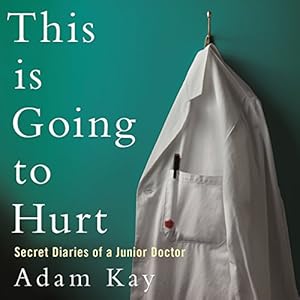
This is Going to Hurt: Secret Diaries of a Junior Doctor by Adam Kay


read by Adam Kay

Adam Kay has given so many interviews and there have been so many prominent reviews of This is Goingto Hurt that a lot of the best jokes and funny episodes have already been aired many times. But don’t let that put you off. Medical students have always told tall tales and usually have a swollen list of anecdotes about their colleagues and patients. Medical black humour is as old as the medical profession itself and the tooth-pulling, grave-robbing, elixir-pushing mountebanks who preceded them. 

At book signings (at which, alas, full recommended price is usually a given), apparently, many a copy of This is Going to Hurt is destined for the (at the time of going to press, as the saying goes) Secretary of State for Health (and Social Care) Jeremy Hunt (he of a privatised NHS fame). Kay has famously shrugged off his medical calling and opted instead for writing and comedy. And if you listen to this audiobook you will find out precisely why.

The tall tales are good (especially as they are narrated by the author). The funny things people do to themselves are, well, excruciatingly funny also. However, the repeated sacrifices of a doctor’s life are saddening and the consequences of underfunding, under resourcing and overworking are chastening.

In the end, despite the jokes that are somehow not jokes at all (‘home delivery is for pizzas not babies’) and the jokes that are, one hopes, jokes (‘the undergraduate learning centre’ being known as the ‘early learning centre’), this is a deepfelt cry for attention from a professional who couldn’t carry on given the shameful and shocking demands on junior doctors of a health service in crisis. 

Shame on all of us to allow this to be.

* * * * *
© copyright 2018 AudioBooksReview. All rights reserved.


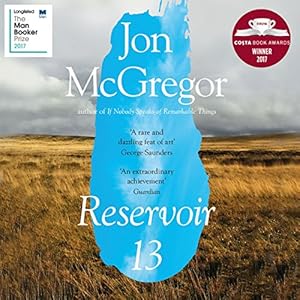
Reservoir 13 by Jon McGregor


read by Matt Bates

A Guardian Book of the Year; a Financial Times Book of the Year; a TLS Book of the Year; an Observer Book of the Year; a Daily Telegraph Book of the Year; winner of the 2017 Costa Novel Award; longlisted for the Man Booker Prize; shortlisted for the Goldsmiths Prize.

This story of the lives haunted by one family’s tragic loss of a teenaged child in a rural English village has been praised to the skies by literary critics, popular critics and the general reader. The books is structured so that each paragraph is a month, each chapter a year, with one extra paragraph at year’s end. For thirteen years. It is slow, thoughtful, poetic. And anyone seeking a resolution to the disappearance will be disappointed. There is none. Which is, perhaps, the point of the whole exercise: often life just goes on. Things might fall apart for a few, but for everyone else life carries on in its infinite sameness.

Perhaps this is Beckett without the humour, Joyce without the wit. Perhaps there is a touch of the emperor’s new clothes: how can the cognoscenti be wrong, with their metropolitan nostalgia for a piece of Albion idyll? Have any critics given less than fulsome praise?

Narrator Matt Bates produces a great performance, but the nuances are better appreciated on the page. It is rather a flat read: uneventful, unremarkable. Impressed by all the acclaim, I am sure many readers and listeners will come away from Reservoir 13 thinking: ‘what is it I missed?’ Many a Christmas present will be left half read and forgotten.

Make up your own mind. 

* * *
© copyright 2018 AudioBooksReview. All rights reserved.


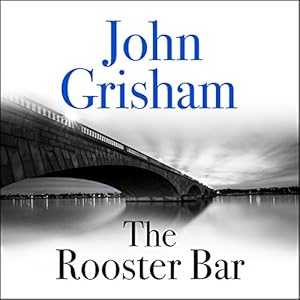
The Rooster Bar by John Grisham

read by Ari Fliakos

Grisham is a long-time favourite of AudioBooksReview. He has the enviable talent of whetting the appetite, getting the juices flowing and then delivering something arguably unsubstantial but generally satisfying to consume and mull over in retrospect.

Characterisation might be a little thin (two of the protagonists of The Rooster Bar, Mark Frazier and Todd Lucero, are at times indistinguishable: something perhaps substantiated by the bedmate they share, prosecutor Hadley Caviness), but the story carries you along and, well, you just have to know how it all ends up. So many books fail in their initial hooks and there are a fair few that, despite rewinding and restarting, your reviewer has never heard further than the opening twenty minutes.
The Rooster Bar fulfils the Grisham promise.

Inspired by an article in American magazine The Atlantic, Grisham’s new book examines the for-profit legal education industry. These new establishments, deemed educational and named ‘universities’, are part of a criminal cohort now plying their cynical trade in England too. In England, annual fees of just under £10,000 are charged by former polytechnics and greedy new colleges, just like older varsities, but which cannot be said to offer anything like a comparable education or qualification.

In The Rooster Bar, Mark Frazier, Todd Lucero and Zola Maal are third-year law students, deep in debt, facing their final term at Foggy Bottom Law School in Washington, DC: a prestigious location, but more dedicated to profit than to learning. Friend and classmate Gordy Tanner has convinced himself of the educational conspiracy whereby law schools admit unqualified students so as to profit from their student loans. Moreover, Foggy Bottom’s owner, a Wall Street lawyer, also has links to one of the banks that specialises in lending to students. Gordy’s discovery tips the balance of his frayed nerves and he jumps off the Arlington Memorial Bridge.

The students, routinely harassed by the banks lending them the money to study, and troubled by their friend’s suicide, eventually decide that enough is enough. They drop out of classes, assume new identities and, with the Rooster Bar as their business address, trawl the lower courts, ambulance chasing, picking up desperate clients for traffic violations and the like so they can practise law without a licence a felony, they reassure themselves, rather than a misdemeanour, but lucrative work and they are learning law on the job, so to speak.

Of course, it all goes right until it doesn’t, with a few unhappy clients and their own creditors starting to close in. A class action, with thousands of complainants who apparently don’t need to be verified to share in a multi-million dollar out-of-court settlement, is the climactic clincher: debts wiped out, money in the bank (lots), early retirement in a warm place with new identities. What could go wrong?

Grisham’s simple morality tales of Davids and Goliaths rarely fail to satisfy. The protagonists might be a trifle two dimensional, but the yarns are entertaining yarns and feed the imagination with plenty of the magical ‘what ifs’ of popular fiction.

Can’t wait for next year’s.

* * * *
© copyright 2018 AudioBooksReview. All rights reserved.


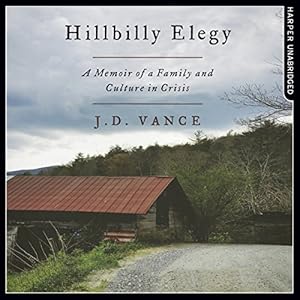
Hillbilly Elegy by J. D. Vance

read by J. D. Vance
Anyone looking for an explanation of why poor white working-class Americans voted for Donald Trump in the 2016 US election will be disappointed by J. D. Vance’s bestselling autobiography. It is a classic American rags to riches tale of social opposites and is slated for Hollywood endorsement in the glory days of the Trump first term. 

But it does not explain how the American poor came to believe Trump’s promises or could possible identify with a man who inherited his wealth from his father, avoided conscription to the war in Vietnam and allegedly employed cruel and bullying tactics to harass rent-controlled tenants from a building he wanted to redevelop overlooking New York’s Central Park.

Vance, a Yale law school-educated investment manager, who has espoused Republican values with a vengeance, rather like the alcoholic who becomes a proselytising teetotaller, gives us his special take on the family and people he has left far behind, the so-called hillbillies of the Appalachian Mountains, and charts the highs and lows of his early life and the lives of his absent father and his substance-abusing mother. His childhood and adolescence are startlingly similar to those of that Californian hillbilly the late Charlie Manson. Vance credits his ability to move away from his roots to the relative stability of his grandmother Mamaw, and a certain amount of luck.

With his wife Usha, Vance is now on the other side of the tracks, and his antipathy and disdain for the so-called ‘Welfare Queens’, the recipients of welfare who have been the enemies of Republicans since the days of Ronald Reagan, is uncompromising. Of those on welfare, he recalls, ‘I could never understand why our lives felt like a struggle while those living off government largesse enjoyed trinkets that I only dreamed about.’

Vance himself was helped first (and probably most) by joining the marines, in a military much less class based than the British, and then by government loans. From the comfort of his now moneyed life, Vance is able to share the uncomprehending anger he has instinctively felt in his new life, particularly with regard to his wife, details of whose background he chooses not to share with his readers, and episodes such as when he spits out Italian sparkling water at a formal dinner, thinking he had been given, possibly unkindly, something unspeakable to drink.

It is not difficult to understand quite why this book has become so garlanded: it seems to confirm everyone’s prejudices, left and right, liberal and conservative. And the sad fact is that little will change in the USA, with the rich getting more and the poor losing more, until everything comes to a breaking point and dissatisfaction with the status quo leads to riot and revolution: Manson’s oh so prescient ‘Helter Skelter’.

* * *
© copyright 2018 AudioBooksReview. All rights reserved.


Camino Island by John Grisham

read by January LaVoy

Grisham can usually be relied upon to deliver the goods: instantly fascinating setting; troubled yet sympathetic protagonist; nasty (generally corporate) villain; unforeseen plot twist; satisfying dénouement. He is a consummate storyteller, even if the prose can be undistinguished. He certainly keeps the listener wanting to learn more (so many audiobooks fall flat within minutes).

Unfortunately, with Camino Island, the ‘Author’s Note’ reveals Grisham’s flaw: ‘I learned with my first novel that writing books is far easier than selling them … I know nothing about the retail side of the business’. He should really stick to what he demonstrably knows a great deal about: the law. In Camino Island, plot and characters really don’t convince. For this listener, his familiarity with academics, university libraries, rare books and even fellow novelists doesn’t ring quite  true.

Grisham’s characters often have a ton of good fortune. Rare book dealer Bruce Cable is no exception. He starts out with money and then discovers that his late father had an enviable library of, mainly American, mainly twentieth-century, first editions:  items easy to overlook as just a collection of second-hand books and a great tax dodge/money laundering vehicle. He buys a bookshop in a tourist paradise and makes a huge success of things: selling books, seducing authors on book signing tours, adding to his collection of rare modern editions, getting for a song one of the best old houses on the island and partnering a beautiful furniture dealer, an expert in French antiques. Everything is so perfect you want to scream. But that, of course, is Grisham’s art. And his charm.

The theft of F. Scott Fitzgerald’s manuscripts from Princeton University. And Bruce Cable’s inveigling into his deceptions of former English  professor cum novelist Mercer Mann, who has been planted on Camino Island by private investigator Donna Watson aka Elaine Shelby, the agent tracking down the priceless masterpieces … is sheer hokum. One comes away from Camino Island reeling off the manifold gaping holes in the plot. But Grisham manages, every pothole notwithstanding, to entertain until the very last word in the book.

 * * * * 
© copyright 2017 AudioBooksReview. All rights reserved.


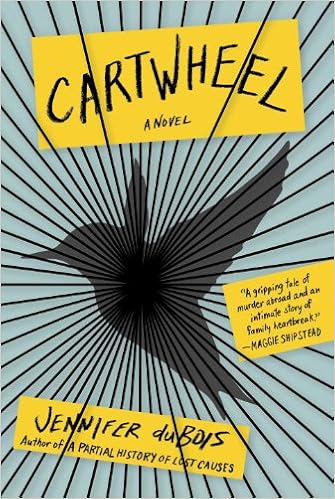
Cartwheel by Jennifer duBois

Read by Emily Rankin


Jennifer duBois showed her prodigious talent in her first novel A Partial History of Lost Causes (not published as an audiobook in the United Kingdom), making one think of Donna Tartt, with her mesmerising prose. And Cartwheel does have a tenuous connection with Tartt’s monumental masterpiece The Secret History, centring as it does on the murder of a university student.

Unashamedly inspired by the story of Amanda Knox (‘loosely’ inspired, duBois claims in a brief epilogue), the murder in question moves from Italy to Argentina, but the raw materials are all derived from Meredith Kercher, Amanda Knox and Raffaele Sollecito, including the cartwheel of the title, which Amanda Knox was widely reported to have performed at the police station after Meredith’s death (although Knox denied this, saying ‘I never did a cartwheel. I did do the splits ... once’). The novel is not exploitative of the Knoxes and the Kerchers very real traumas and grief. The events in Perugia are simply the spur that pricked duBois’s unequalled talent for place, time, character, motivation, voice, consequences. Lily Hayes is not Amanda Knox and Katy Kellers is not Meredith Kercher. But all the unanswered questions of Perugia resurface in Cartwheel. And, in this exceptional book, many of the same doubts still linger.

Emily Rankin’s reading is seamless: not too tense or melodramatic: thoroughly engaged. And well worth a second or third listen. 

Haunting.

* * * * *
© copyright 2017 AudioBooksReview. All rights reserved.


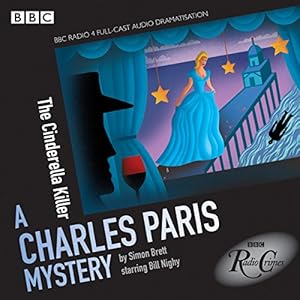
The Cinderella Killer by Simon Brett

Dramatised by Jeremy Front:  BBC Radio 4 Full Cast Recording

If you have never treated yourself to one of Simon Brett’s Charles Paris creations you have missed out on a good many hours of sheer pleasure. Bill Nighy is perfect as actor Charles Paris, perhaps just beyond his best days, struggling with ex-wife Frances (Suzanne Burden) and the always-busy-with-more-famous-clients agent Maurice (Jon Glover).  ‘Hi-ho, the glamorous life!’ as Stephen Sondheim famously puts it in ‘A Little Night Music’.

Whether it is in the television or radio studio, but much more probably in provincial rep., Paris always seems to find himself in the middle of intrigue and murder, often mirroring the plot of the plays in which he manages to land a part.

In The Cinderella Killer, Paris tries his hand at provincial panto, having suffered as a department store Santa the nastiness of children grabbing his beard, poking his stomach and micturating as they sit on his lap. Surely, Maurice can find something more befitting his prodigious thespian talents and lengthy résumé.

But panto is better than nothing and Charles is soon glad-handing old mates and finding drinking buddies with new best friends. Meanwhile, things are going better with his ex and he is even making the late-night train back to town rather than staying in off-season lodgings with a dodgy seaside landlady. However,  murder and intrigue are never far away. Actors are an unforgiving lot, and what with stage-door groupies and an American TV actor with a questionable history, Kensington Gore (out of place at panto time, surely) soon turns into the real thing.

This is BBC radio at its best: two hours of drama, suspense and good old dry wit worth visiting and revisiting many a time and oft. Why Bill Nighy hasn’t been knighted is a mystery. Likewise, Simon Brett, a comic genius up there with Waugh and Wodehouse.

Unsurpassed. (Until the next one.)

* * * * *
© copyright 2017 AudioBooksReview. All rights reserved.