Showing posts with label Audible. Show all posts

Blood on the Page by Thomas Harding


read by Thomas Harding

The death of author Allan Chappelow in Hampstead in 2006 was widely covered in the press and on television, as was the trial of Wang Yam, jailed in 2009 for his murder. 

The eccentricity of the reclusive Chappelow, who had lived in the house in Downshire Hill where his body was found all his life, makes for compulsive reading. At the time of his death, Chappelow’s house was in almost total disrepair, with a collapsed roof, a kitchen that hadn’t been used for years and once elegant rooms filled with broken furniture, rubble, books and (literally) tons of paper. In one room, a tree was growing through the floorboards. 

Chappelow’s body was not discovered by the police for four days after they had let themselves into his house, smothered as he was in what must have been page proofs of his several books. The police had called at his address to investigate what was probably identity fraud when his bank alerted them that someone was trying to transfer money from one of his bank accounts.

He had clearly been bludgeoned to death and an attempt had been made to burn his body. The police eventually arrested a Chinese ‘dissident’, Wang Yam, who had been granted asylum in the early 1990s and had led a troubled life in England. Yam was clearly implicated in some elements of fraud (he appears to have sold mortgages to members of the Asian community, bounced cheques and before his arrest posed as a wealthy property owner being shown around multimillion-pound properties in North London). But there was no unambiguous evidence linking him to the murder, and he protested his innocence from the very start.

What makes the case and Harding’s book so fascinating and frustrating at the same time is the suggestion of Yam’s involvement with Britain’s secret services. Much of the trial at the Old Bailey was held in camera, unheard of in murder trials in western democracies. Harding received a warning in writing from the Ministry of Justice’s [sic] litigation department stating that they wished to draw the author’s attention to the ‘gagging order’ which had the effect of preventing publication of anything heard in court in camera and that breach of the order would be punishable by imprisonment.

There is a website to accompany the book (www.bloodonthepage.com) which contains more ‘speculation’ than Harding (and his lawyers) allowed to appear in the book, most of it from the Daily Mail, the Mirror, Camden New Journal, the Guardian and The Times. It is ridiculous that even to infer anything from the facts of the secrecy surrounding the trial would be judged contempt of court.
So much for freedom of speech.

It is clear, nevertheless, that there is very little in the public domain apart from circumstantial evidence that Yam killed Allan Chappelow. His rights of appeal have been summarily rejected. He will spend the rest of his sentence in prison. The author has not been allowed to visit him, but during the writing of the book he was in communication by phone. Yam’s state of mind is, according to Harding, crushed by events. And prisons, as we know, are not safe places. It is quite possible his life is in danger from either Chinese gangs (Yam kept saying that it was they who were behind the identity theft) or the authorities. Under the circumstances, don’t be surprised to read of his death before he becomes eligible for parole.

The book is arranged, like most true crime books, chronologically, in terms of the discovery of the crime and its early investigation and then the life stories of the victim and the prime suspect. There are also sections entitled ‘Case Notes’ in which the author charts the progress of his own investigation: his interviews with relatives of the victim, with police and counsel and with people who knew something of Wang Yam’s life. He also documents his phone calls with Yam. The style is journalistic: the story has its own momentum. Another commentator has noted the author’s fondness for splitting infinitives. His reading style is not that of a professional narrator: but one somehow always gains insights when an author reads his own words.

If you like true crime, then this will not disappoint. ‘Unputdownable’ is overused praise in the book trade, but in the case of Blood on the Page, I think it fits the bill.

* * * * *
© copyright 2018 AudioBooksReview. All rights reserved.

Buy Blood on the Page

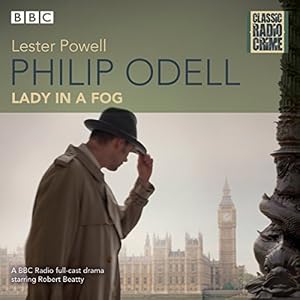
Philip Odell: Lady in a Fog by Lester Powell


BBC Radio Full-Cast Drama

Writer Lester Powell is a part of radio history. His output was prolific, with more than sixty plays and serials to his name broadcast from just after the Second World War in 1946 until the 1980s. Most, alas are lost, never to be heard again.
Powell started writing radio adaptations of famous novels and short stories that went out on the BBC Light Programme, including some of G. K. Chesterton’s Father Brown detective stories. 

The detective genre was always popular on radio, just as police procedurals are on today’s television. Listeners to Radio 4 and Radio 4 Extra will know Francis Durbridge’s Paul Temple programmes, but some younger listeners will not be familiar with Lester Powell’s detective Philip Odell, the Irish sleuth who starred in seven radio serials, several novels and a feature film. Powell said that he had Raymond Chandler’s Philip Marlowe in mind when he created Odell, and there is much of Marlowe in Powell’s tough and dogged but fair detective played by Canadian actor Robert Beatty. His sidekick (and lover) Heather McMara was played by a number of actresses, including Brenda Bruce, Joy Shelton, Joyce Heron, Diana Olsson and Sheila Manahan.

Lady in a Fog was the first story to feature Odell and McMara and was broadcast in eight instalments in 1947, possibly in live transmissions, because the Lady in a Fog in the CDs under review is a second production, this time recorded for posterity, staged in 1958. Only one other recording of the Odell stories is said to exist.

In Lady in a Fog, Odell is on his way home to Ireland, but the flight is delayed because of a heavy London fog. He calls on Heather McMara only to learn that Heather’s brother has just been found drowned in the Thames. So starts Odell’s investigation and his run-ins with the police in the shape of Inspector Rigby, who thinks Odell might well be their best suspect when more murders start to turn up.
It would be interesting to be able to compare the 1947 and 1958 broadcasts, but that of course is impossible. Are the 1958 actors deliberately stressing the huge class differences in the protagonists that would have been evident in the 1940s? Or were they still there a decade later? It is always slightly shocking just how cut glass the accents are of some of the actors in ‘classic’ BBC drama from the middle of the twentieth century. But that too is often the appeal of these recordings.

It is probably pointless to try to summarise the plot, which follows a Marlowesque trail of low-life and patrician criminals, interfering police, the odd red herring, some romance. Odell never makes it back to Dublin but is set on his career as a private investigator in London.

There is much to enjoy in this four-hour, eight-part serial, with performances from a large cast of BBC Drama Repertory Company stalwart’s including Mary Wimbush, James Thomason, John Bennett, Jeffrey Segal, June Tobin, David March and Trevor Martin.

Peerless.

* * * * *
© copyright 2018 AudioBooksReview. All rights reserved.

Buy Lady in a Fog

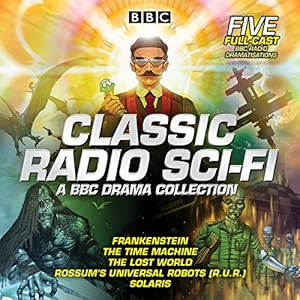
Classic Radio Sci-Fi


BBC Drama Collection: Five BBC Radio Full-Cast Dramatisations

This collection contains almost ten hours of first-class radio ranging from the 1975 Radio 4 adaptation of Conan Doyle’s Lost World to the 1989 Radio 3 presentation of Czech writer Karel Čapek’s 1921 play Rossum’s Universal Robots (R.U.R.) and the 2007 Radio 4 dramatisation of Polish author Stanisław Lem’s 1961 novel Solaris. It is a great pity that the 1941 BBC radio version of R.U.R. is lost, but then so much classic radio has gone forever (perhaps to be picked up only in a distant galaxy).

R.U.R. and Solaris are unique, thought-provoking pieces, important culturally and from a literary point of view. I would like to see these issued as standalone productions, perhaps with an introduction from a Braggian team of commentators.   

Frankenstein and The Time Machine are relatively recent BBC Radio productions (1994 and 2009 respectively) and display all the great acting and technical presentation skills that modern stereo production brings to radio. DAB and Internet Radio quality is superb and these CDs deserve to be listened to through good headphones rather than in the car.

Perhaps the most interesting play from the point of view of the radio enthusiast is Conan Doyle’s Lost World. This too might well have deserved publication on its own. The three CDs have a cast representing the best of BBC radio drama from the 1970s, with Francis De Wolff, Kevin McHugh, Carleton Hobbs and Gerald Harper (of BBC television’s Adam Adamant fame). The music and special effects from the BBC Radiophonic Workshop are especially good and, of course, the drama itself is one of Conan Doyle’s best creations.

* * * * *
© copyright 2018 AudioBooksReview. All rights reserved.

Buy Classic Radio Sci-Fi

This is Going to Hurt: Secret Diaries of a Junior Doctor by Adam Kay


read by Adam Kay

Adam Kay has given so many interviews and there have been so many prominent reviews of This is Goingto Hurt that a lot of the best jokes and funny episodes have already been aired many times. But don’t let that put you off. Medical students have always told tall tales and usually have a swollen list of anecdotes about their colleagues and patients. Medical black humour is as old as the medical profession itself and the tooth-pulling, grave-robbing, elixir-pushing mountebanks who preceded them. 

At book signings (at which, alas, full recommended price is usually a given), apparently, many a copy of This is Going to Hurt is destined for the (at the time of going to press, as the saying goes) Secretary of State for Health (and Social Care) Jeremy Hunt (he of a privatised NHS fame). Kay has famously shrugged off his medical calling and opted instead for writing and comedy. And if you listen to this audiobook you will find out precisely why.

The tall tales are good (especially as they are narrated by the author). The funny things people do to themselves are, well, excruciatingly funny also. However, the repeated sacrifices of a doctor’s life are saddening and the consequences of underfunding, under resourcing and overworking are chastening.

In the end, despite the jokes that are somehow not jokes at all (‘home delivery is for pizzas not babies’) and the jokes that are, one hopes, jokes (‘the undergraduate learning centre’ being known as the ‘early learning centre’), this is a deepfelt cry for attention from a professional who couldn’t carry on given the shameful and shocking demands on junior doctors of a health service in crisis. 

Shame on all of us to allow this to be.

* * * * *
© copyright 2018 AudioBooksReview. All rights reserved.


Reservoir 13 by Jon McGregor


read by Matt Bates

A Guardian Book of the Year; a Financial Times Book of the Year; a TLS Book of the Year; an Observer Book of the Year; a Daily Telegraph Book of the Year; winner of the 2017 Costa Novel Award; longlisted for the Man Booker Prize; shortlisted for the Goldsmiths Prize.

This story of the lives haunted by one family’s tragic loss of a teenaged child in a rural English village has been praised to the skies by literary critics, popular critics and the general reader. The books is structured so that each paragraph is a month, each chapter a year, with one extra paragraph at year’s end. For thirteen years. It is slow, thoughtful, poetic. And anyone seeking a resolution to the disappearance will be disappointed. There is none. Which is, perhaps, the point of the whole exercise: often life just goes on. Things might fall apart for a few, but for everyone else life carries on in its infinite sameness.

Perhaps this is Beckett without the humour, Joyce without the wit. Perhaps there is a touch of the emperor’s new clothes: how can the cognoscenti be wrong, with their metropolitan nostalgia for a piece of Albion idyll? Have any critics given less than fulsome praise?

Narrator Matt Bates produces a great performance, but the nuances are better appreciated on the page. It is rather a flat read: uneventful, unremarkable. Impressed by all the acclaim, I am sure many readers and listeners will come away from Reservoir 13 thinking: ‘what is it I missed?’ Many a Christmas present will be left half read and forgotten.

Make up your own mind. 

* * *
© copyright 2018 AudioBooksReview. All rights reserved.


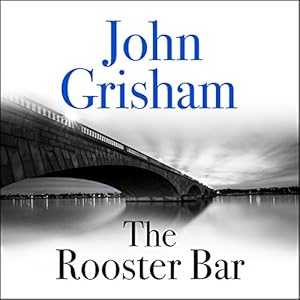
The Rooster Bar by John Grisham

read by Ari Fliakos

Grisham is a long-time favourite of AudioBooksReview. He has the enviable talent of whetting the appetite, getting the juices flowing and then delivering something arguably unsubstantial but generally satisfying to consume and mull over in retrospect.

Characterisation might be a little thin (two of the protagonists of The Rooster Bar, Mark Frazier and Todd Lucero, are at times indistinguishable: something perhaps substantiated by the bedmate they share, prosecutor Hadley Caviness), but the story carries you along and, well, you just have to know how it all ends up. So many books fail in their initial hooks and there are a fair few that, despite rewinding and restarting, your reviewer has never heard further than the opening twenty minutes.
The Rooster Bar fulfils the Grisham promise.

Inspired by an article in American magazine The Atlantic, Grisham’s new book examines the for-profit legal education industry. These new establishments, deemed educational and named ‘universities’, are part of a criminal cohort now plying their cynical trade in England too. In England, annual fees of just under £10,000 are charged by former polytechnics and greedy new colleges, just like older varsities, but which cannot be said to offer anything like a comparable education or qualification.

In The Rooster Bar, Mark Frazier, Todd Lucero and Zola Maal are third-year law students, deep in debt, facing their final term at Foggy Bottom Law School in Washington, DC: a prestigious location, but more dedicated to profit than to learning. Friend and classmate Gordy Tanner has convinced himself of the educational conspiracy whereby law schools admit unqualified students so as to profit from their student loans. Moreover, Foggy Bottom’s owner, a Wall Street lawyer, also has links to one of the banks that specialises in lending to students. Gordy’s discovery tips the balance of his frayed nerves and he jumps off the Arlington Memorial Bridge.

The students, routinely harassed by the banks lending them the money to study, and troubled by their friend’s suicide, eventually decide that enough is enough. They drop out of classes, assume new identities and, with the Rooster Bar as their business address, trawl the lower courts, ambulance chasing, picking up desperate clients for traffic violations and the like so they can practise law without a licence a felony, they reassure themselves, rather than a misdemeanour, but lucrative work and they are learning law on the job, so to speak.

Of course, it all goes right until it doesn’t, with a few unhappy clients and their own creditors starting to close in. A class action, with thousands of complainants who apparently don’t need to be verified to share in a multi-million dollar out-of-court settlement, is the climactic clincher: debts wiped out, money in the bank (lots), early retirement in a warm place with new identities. What could go wrong?

Grisham’s simple morality tales of Davids and Goliaths rarely fail to satisfy. The protagonists might be a trifle two dimensional, but the yarns are entertaining yarns and feed the imagination with plenty of the magical ‘what ifs’ of popular fiction.

Can’t wait for next year’s.

* * * *
© copyright 2018 AudioBooksReview. All rights reserved.


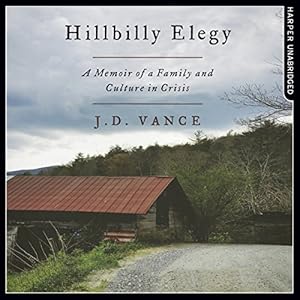
Hillbilly Elegy by J. D. Vance

read by J. D. Vance
Anyone looking for an explanation of why poor white working-class Americans voted for Donald Trump in the 2016 US election will be disappointed by J. D. Vance’s bestselling autobiography. It is a classic American rags to riches tale of social opposites and is slated for Hollywood endorsement in the glory days of the Trump first term. 

But it does not explain how the American poor came to believe Trump’s promises or could possible identify with a man who inherited his wealth from his father, avoided conscription to the war in Vietnam and allegedly employed cruel and bullying tactics to harass rent-controlled tenants from a building he wanted to redevelop overlooking New York’s Central Park.

Vance, a Yale law school-educated investment manager, who has espoused Republican values with a vengeance, rather like the alcoholic who becomes a proselytising teetotaller, gives us his special take on the family and people he has left far behind, the so-called hillbillies of the Appalachian Mountains, and charts the highs and lows of his early life and the lives of his absent father and his substance-abusing mother. His childhood and adolescence are startlingly similar to those of that Californian hillbilly the late Charlie Manson. Vance credits his ability to move away from his roots to the relative stability of his grandmother Mamaw, and a certain amount of luck.

With his wife Usha, Vance is now on the other side of the tracks, and his antipathy and disdain for the so-called ‘Welfare Queens’, the recipients of welfare who have been the enemies of Republicans since the days of Ronald Reagan, is uncompromising. Of those on welfare, he recalls, ‘I could never understand why our lives felt like a struggle while those living off government largesse enjoyed trinkets that I only dreamed about.’

Vance himself was helped first (and probably most) by joining the marines, in a military much less class based than the British, and then by government loans. From the comfort of his now moneyed life, Vance is able to share the uncomprehending anger he has instinctively felt in his new life, particularly with regard to his wife, details of whose background he chooses not to share with his readers, and episodes such as when he spits out Italian sparkling water at a formal dinner, thinking he had been given, possibly unkindly, something unspeakable to drink.

It is not difficult to understand quite why this book has become so garlanded: it seems to confirm everyone’s prejudices, left and right, liberal and conservative. And the sad fact is that little will change in the USA, with the rich getting more and the poor losing more, until everything comes to a breaking point and dissatisfaction with the status quo leads to riot and revolution: Manson’s oh so prescient ‘Helter Skelter’.

* * *
© copyright 2018 AudioBooksReview. All rights reserved.


Camino Island by John Grisham

read by January LaVoy

Grisham can usually be relied upon to deliver the goods: instantly fascinating setting; troubled yet sympathetic protagonist; nasty (generally corporate) villain; unforeseen plot twist; satisfying dénouement. He is a consummate storyteller, even if the prose can be undistinguished. He certainly keeps the listener wanting to learn more (so many audiobooks fall flat within minutes).

Unfortunately, with Camino Island, the ‘Author’s Note’ reveals Grisham’s flaw: ‘I learned with my first novel that writing books is far easier than selling them … I know nothing about the retail side of the business’. He should really stick to what he demonstrably knows a great deal about: the law. In Camino Island, plot and characters really don’t convince. For this listener, his familiarity with academics, university libraries, rare books and even fellow novelists doesn’t ring quite  true.

Grisham’s characters often have a ton of good fortune. Rare book dealer Bruce Cable is no exception. He starts out with money and then discovers that his late father had an enviable library of, mainly American, mainly twentieth-century, first editions:  items easy to overlook as just a collection of second-hand books and a great tax dodge/money laundering vehicle. He buys a bookshop in a tourist paradise and makes a huge success of things: selling books, seducing authors on book signing tours, adding to his collection of rare modern editions, getting for a song one of the best old houses on the island and partnering a beautiful furniture dealer, an expert in French antiques. Everything is so perfect you want to scream. But that, of course, is Grisham’s art. And his charm.

The theft of F. Scott Fitzgerald’s manuscripts from Princeton University. And Bruce Cable’s inveigling into his deceptions of former English  professor cum novelist Mercer Mann, who has been planted on Camino Island by private investigator Donna Watson aka Elaine Shelby, the agent tracking down the priceless masterpieces … is sheer hokum. One comes away from Camino Island reeling off the manifold gaping holes in the plot. But Grisham manages, every pothole notwithstanding, to entertain until the very last word in the book.

 * * * * 
© copyright 2017 AudioBooksReview. All rights reserved.


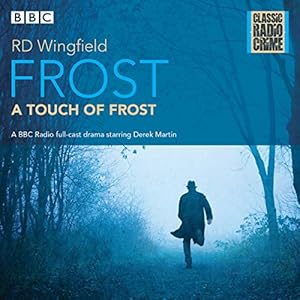
A Touch of Frost by R. D. Wingfield

BBC Radio 4 Full Cast Recording


Although best known now for the ITV series which ran from the early 1990s to the 2010s starring David Jason, Detective Inspector Jack Frost was the  main protagonist in a gritty novel, rejected by publishers Macmillan in 1972, that R. D. Wingfield turned into a radio drama for BBC Radio 4.  Currently unavailable, Three Days of Frost saw the Inspector investigating child abuse and murder in a city named Denton – a provincial locale in the grimy nowhere of the north of England. In 1982, Frost reappeared in A Touch of Frost, and a legend was created.

Starring Derek Martin as Frost, with Haydn Wood, Stephen Thorne and Alan Dudley, A Touch of Frost is very much of its time in terms of attitudes to, for example, Women Police Constables (as they were referred to then), women in general, and teenagers and their parents. But the writing is first class, full of psychological tension, gritty reality and palpable despair. Despite working on cases involving a multiple rapist, a sleazy and corrupt club owner and the distraught parents of a runaway schoolgirl, Frost gets his man in the end. He even gets his paperwork in on time – just. But not, of course, without alienating his colleagues and superiors.

Running to only just under 90 minutes,  A Touch of Frost is a perfect way to while away a tedious car journey and it leaves you wishing that more of Wingfield’s work could be made available from the BBC Radio Archive.

Masterly.

* * * *
© copyright 2017 AudioBooksReview. All rights reserved.


John Wyndham: BBC Radio Drama Collection

Six Full Cast Classic BBC Radio Dramatisations


Lightly dismissed as ‘middle-class catastrophes’ and ‘cosy disasters’, John Wyndham’s novels, written chiefly in the 1950s and 1960s, are still chillingly shocking and disturbing dramas that make the reader question what we, as humans, are doing to our planet and, crucially, whether we are alone in the vastness of those universes beyond our own.

The Day of the Triffids, The Kraken Wakes and The Midwich Cuckoos are probably read less now than at any time in their publishing history (although it is interesting to see that H. G. Wells’ War of the Worlds is currently on one GCSE English Literature syllabus). Wyndham’s novels are, perhaps, ‘an easy read’, but much of their appeal is the way he turns upside down a tranquil world where the last thing on people’s minds is the thought that anything could prevent life from continuing as it had done since the turmoil and upheaval of the protracted end to the Second World War.

These BBC radio dramatisations are enjoyable first of all for the retelling of the novels, but then for the insight we are given into the radio writers, actors, producers and audiences at the time of the original broadcasts. The accents of the lead actors in The Day of the Triffids, for example – Gary Watson, who made his name in countless television dramas, and Barbara Shelley, famous for her Hammer Film roles (playing Bill Masen and Josella Playton)  –  sound to modern ears frightfully cut glass. Few actors today would even attempt such accents, but they are perfect for this post-war apocalypse (dramatised by BBC radio drama pioneer Giles Cooper and first broadcast in 1968). But that is part of the appeal of this collection.

A fascinating feature of The Day of the Triffids is that the transcriptions are episodes shortened for sale to foreign broadcasters, most of whom needed time for commercials. Anything deemed ‘inappropriate’ for a overseas audience was routinely cut. Twelve minutes of the deleted material is included here on the final CD of Triffids.

Of the other broadcasts, The Kraken Wakes, from 1998, is rather prescient in the light of the rise in sea levels through global warming. As the Thames breaks its banks and then submerges the Houses of Parliament, the listener is left realising that this modern-day Noah’s Flood is perhaps not so far-fetched.

Chocky (from 1998) is fascinating, as a schoolboy communicates with an entity from the future, a ‘girl’ (although there is only one gender on her planet) who is trying to impart the secrets of an energy source that will save the Earth from eventual destruction. Fables of Nikola Tesla’s inventions and conspiracy theories that the petro-chemical industry in the USA tried to interfere with work on the electric car all spring to mind as twelve-year-old Matthew is kidnapped, hypnotised and threatened when it is revealed that he may be the conduit for a new science emanating from a different world. The dramatisation is gripping and absorbing and John Constable’s script is excellent, building as it does to its inevitable denouement. John Tydeman produced a version for BBC Radio in 1967; it would be great to be able to hear that version too.

Perhaps the best of the six here is Dan Rebellato’s 2003 production of The Midwich Cuckoos (again, there was an earlier version by William Ingram). Bill Nighy and Sarah Parish are perfect as Richard and Janet, who are fortunate enough to stay away from the village of Midwich on the night when all the women, young and old, married and single, find themselves ‘with child’. Controversial for its time, and disturbing still today, issues of abortion, eugenics and egg-sharing are not far from the surface of this intriguing and disturbing mystery, displaying just how current Wyndham still is in the second decade of the twenty-first century.


Essential.  
* * * * * 
© copyright 2017 AudioBooksReview. All rights reserved.

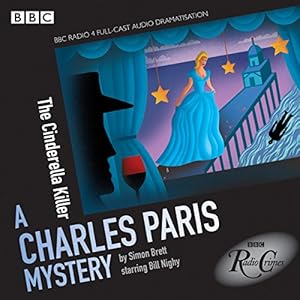
The Cinderella Killer by Simon Brett

Dramatised by Jeremy Front:  BBC Radio 4 Full Cast Recording

If you have never treated yourself to one of Simon Brett’s Charles Paris creations you have missed out on a good many hours of sheer pleasure. Bill Nighy is perfect as actor Charles Paris, perhaps just beyond his best days, struggling with ex-wife Frances (Suzanne Burden) and the always-busy-with-more-famous-clients agent Maurice (Jon Glover).  ‘Hi-ho, the glamorous life!’ as Stephen Sondheim famously puts it in ‘A Little Night Music’.

Whether it is in the television or radio studio, but much more probably in provincial rep., Paris always seems to find himself in the middle of intrigue and murder, often mirroring the plot of the plays in which he manages to land a part.

In The Cinderella Killer, Paris tries his hand at provincial panto, having suffered as a department store Santa the nastiness of children grabbing his beard, poking his stomach and micturating as they sit on his lap. Surely, Maurice can find something more befitting his prodigious thespian talents and lengthy résumé.

But panto is better than nothing and Charles is soon glad-handing old mates and finding drinking buddies with new best friends. Meanwhile, things are going better with his ex and he is even making the late-night train back to town rather than staying in off-season lodgings with a dodgy seaside landlady. However,  murder and intrigue are never far away. Actors are an unforgiving lot, and what with stage-door groupies and an American TV actor with a questionable history, Kensington Gore (out of place at panto time, surely) soon turns into the real thing.

This is BBC radio at its best: two hours of drama, suspense and good old dry wit worth visiting and revisiting many a time and oft. Why Bill Nighy hasn’t been knighted is a mystery. Likewise, Simon Brett, a comic genius up there with Waugh and Wodehouse.

Unsurpassed. (Until the next one.)

* * * * *
© copyright 2017 AudioBooksReview. All rights reserved.

Dracula by Bram Stoker

Adapted and dramatised by Liz Lochhead, with Ellie Beaven, Rebecca Callard, Tom Hiddleston and David Suchet

There is no denying the lasting power of Bram Stoker’s tale of the evil that is Count Dracula. The Count’s plan to move from his homeland in Transylvania to England and to become a member of Victorian English aristocracy is familiar through film and television and displays, perhaps, the cultural gulf between Eastern Europe and Western Europe still evident today.

Like many literary classics, few people in the twenty-first century have the time and patience to read the original, preferring to digest others’ versions and adaptations. Appearing in print in 1897, Stoker’s prose is not the greatest writing of the time from the pen of an Irishman, but it is better than that of some more contemporary authors who write tales of the Un-dead (Stoker’s original title for the novel).

Noteworthy is the epistolary method of story-telling, using letters and diaries, which works exceptionally well given the story-line: Jonathan Harker is confined in the Count’s castle and, unable to send or receive letters, keeps a written account of his journey and of his time with the Count. The exchange of letters between the other characters, ships’ logs and newspaper clippings drive the story on and perhaps reveal more about the protagonists’ inner thoughts than might more conventional writing.

It also make Dracula perfect for radio, and this BBC World Service dramatisation, judiciously abridged and adapted for the medium, is a rare triumph and well worth two hours of anyone’s time. Stereo makes the whole thing come very much alive (if that isn’t too great an irony) and the performances are exemplary. David Suchet’s Dracula is spine-chilling, mixing aristocratic disdain with psychopathic superciliousness. Ellie Beaven (Mina) and Rebecca Callard (Lucy) provide just the right amount of flirtatiousness and suppressed eroticism, and Tom Hiddleston (Jonathan Harker) is perfect as the straight-laced and hugely naive country solicitor.

Whilst the lengthy original certainly repays perseverance, the BBC’s Dracula provides an intense and very palpable sense of menace in the figure of one of the first stalkers in literature and his merciless pursuit of victims to feed his insatiable appetites.

Superb.

* * * * *

© copyright 2016 AudioBooksReview. All rights reserved.

Buy Dracula

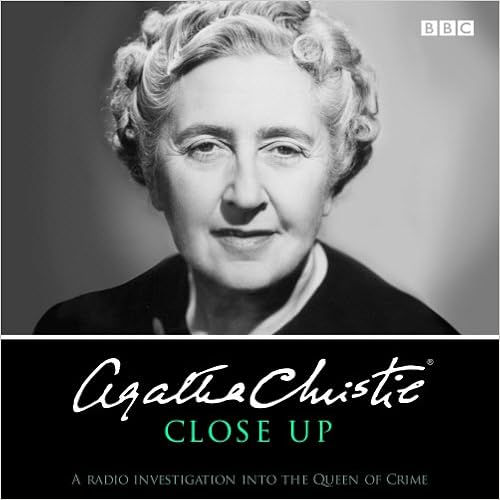
Agatha Christie, Close-Up

Four BBC Radio documentaries about the Queen of Crime

Queen of Crime, Agatha Christie, was a curiously private person and, despite living until 1976, very few recordings of her discussing her work have survived: she was from a very different time indeed.

In this remarkable audiobook, the BBC has brought together four radio programmes about Christie the woman, the writer and the phenomenon. For she captivated and fascinated a loyal readership from the very first detective novel, The Mysterious Affair at Styles, which she published in 1920, right up to the present day, almost one hundred years later.

The characters she created, including Hercule Poirot and Miss Marple, to name just two, and her stories and plays, are just as much in demand today as they ever were: still in print, but also on the small and silver screens, and still regularly in amateur and professional theatre companies in the provinces and in the West End. She really is a truly singular literary phenomenon.

Because so little exists of recordings of Christie, some of the material in these programmes is heard more than once. But that matters not a jot. Each programme tells a different part of her extraordinary story, with contributions from, amongst many others, Richard Attenborough, Allen Lane, Marghanita Laski, Cliff Michelmore, A. L. Rowse and Nigel Stock. The programmes range in date from 1955 (for the Light Programme) to 1975 and 1982, with a new contribution for Radio 4 Extra produced by Peter Reed in 2015/16, and will delight any Christie devotee, of which there are many all over the world.

A perfect Christmas gift for aficionados of Agatha Christie, one interesting feature to note is the changing voice of the BBC – or rather the changing accent of the BBC. Vanished now is received pronunciation, or RP –  the educated voice of the privileged Home counties. How differently people speak today compared with the 1950s, 60s and 70s: even actors, broadcasters and other professionals. Does no one speak that way any more? And what, one wonders, will things be like in another fifty years?

Indispensable.

* * * * *

© copyright 2016 AudioBooksReview. All rights reserved.

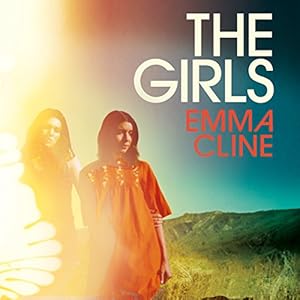
The Girls by Emma Cline

read by Cady McClain

The Girls has achieved a startling and almost unprecedented amount of attention in all media for its author Emma Cline – as well as an enviable advance, which, judging from the print and radio reviews that have so far appeared, should pay royally for the publishers’ three-book deal. It also was pirated online on publication day, which might be a further measure of its notoriety and success.

With the Manson murders now almost fifty years ago (1969) and the recent release on parole of Leslie Van Houten, one of the many convicted of complicity in the senseless and brutal Tate–La Bianca murders, much can only be expected in the next few years to recount the goings-on of the Family and Charlie Manson at Spahn Ranch, in the Hollywood Hills. Fire consumed the ranch fairly soon after the Manson trials, which might otherwise have been turned into a tourist destination. Many of those convicted are dead. Manson enjoys a cultish following, complete with website selling t shirts, music and ‘memorabilia’. The late Vincent Bugliosi’s account of his part in bringing Manson to justice remains a fascinating record of the LAPD at the time and of the sixties judicial system in the USA. It is a masterpiece in its own right and repays a close listen in the outstanding audiobook version read by Scott Brick.

So the only question remains might be why it took so long to turn the stories, especially the stories of Manson’s loyal ‘girls’ into fiction. There have been a number of mainly ghost-written accounts of life at Spahn by a few of the people who hung out there, including some of those convicted and imprisoned. But The Girls is arguably the first fully to exploit the possibilities. 

And although the book makes for a compelling listen, I can’t quite see what all the fuss is about. As YA fiction it ticks all those stereotypical boxes. But haven’t others done this before? And better? Robin Wasserman’s Girls on Fire, for example, is more convincing, scarier, more visceral. Alison Umminger’s My Favourite Manson Girl is, I think, pithier and better written.

I hesitate over the creation of ‘Russell’ – the Charles Manson character. ‘Russell’ lacks the common quasi-friendly feeling of a Charles or a Charlie (think Chaplin and his girls). And so much is significant in the hint that Charlie was Christ, the son of God, of Man – Man’s Son – that ‘Russell’ just doesn’t even slightly hint at. I know this is fiction. But the cult idea and Russell’s musical ambitions, his way of making the most of anyone with the slightest influence or connection with fame, stardom and its inherent wealth are well exploited in The Girls. But, despite his depiction as a guitarist and his deep yearning for a recording contract, where is the music in the book? Where are the racial elements, the Bible, the obsession with others musicians’ lyrics? What is missing is some kind of helter skelter.

Cline’s prose has been praised. And there are fine passages. The fourteen-year-old Evie Boyd, with all her adolescent angst and desperation is good. But the middle-aged Evie is no monster: her links with the murders are third hand, her love for Susanna unconvincing.

What we were led to believe was an American masterpiece is oddly unsatisfying and ultimately a disappointment. There is a fine book waiting to burst out from the raw bones of this novel, but I believe a good editor should have told the author to go back and make more of some great material. It could have been a work that would have stayed the test of time. As it is, I fear it will be easily eclipsed by all those other authors looking to build on the allure of a cult and the ghastly reverberations of a society that produced Charles Manson’s Family.

* *

© copyright 2016 AudioBooksReview. All rights reserved.
Buy The Girls

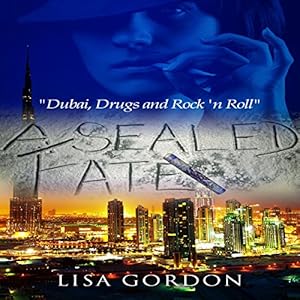
A Sealed Fate by Lisa Gordon

read by Lisa Gordon
Lisa Gordon’s novel is a fine example of the storyteller’s art. She creates characters, situations and atmosphere that draw you in and make you hungry to discover exactly where the story is going. Ranging from South Africa to London, most of the action takes place in Dubai, and the combination of wealth, glitzy nightspots, drugs and unusual deaths keep you guessing from start to finish.
Valda is a singer, escaping from a long-term relationship that has just ended - by taking a well-paid gig at a nightclub and restaurant in Dubai. Her feisty self-confidence and instinctive independence make her highly suspicious of the nightclub’s owner, the fabulously wealthy Sheikh Abdullah. He asks her  first to do some ‘shopping’ for him: something for ‘sciatica relief’ from an out of the way health store in Cape Town. After a nerve-wracking initial journey to locate the shop, and a preliminary look around, she finally screws up the courage to buy the ‘medicine’, which turns out to be white powder that she guesses must be cocaine.
Ever resourceful, she disguises the stuff as a gift, complete with ribbon, and finds some dog repellent to throw the drug- sniffing canines off the scent on her return flight to Dubai. The Sheikh shows his gratitude by installing Valda in one of his swish apartments and giving her an extravagant sports car. Meanwhile, someone keeps sending her clippings from old newspapers describing suspicious deaths and disappearances of ex-pats in Dubai.
Helped by a new friend Lara, Valda still has a few more crises to weather before she can escape the increasingly dangerous world she now inhabits. And there are many twists and unexpected turns before the startling, unanticipated denouement.
Lisa Gordon’s South African accent is perfect for this tale - a refreshing change from British or American English - and she reads like a real pro (though her British regional accents might do with some coaching). Notwithstanding, A Sealed Fate is a fast and furious and intriguing ride. 
Highly recommended.
* * * * *
© copyright 2016 AudioBooksReview. All rights reserved.

Toilers of the Sea by Victor Hugo

read by Patrick Dickson

Apart from the plays of Ibsen and Chekov, which for some reason have always been part of the so-called canon of English literature, readers whose first language is English are not too keen on translations from other tongues. And this is rarely because we can easily read them in the original. Much Greek and Latin writing is unfamiliar to modern readers, let alone the Decameron or the Divine Comedy. Crime and Punishment, Dr Zhivago, Don Quixote and a few others (the Bible, for example) might be exceptions, but English versions of writers in other languages are, comparatively speaking, few and often centuries between.

Victor Hugo’s novels and short stories are little known except in different media, such as the phenomenally successful ‘Les Mis’ or the stage, feature film and cartoon versions of The Hunchback of Notre Dame. So it is a treat to hear Hugo’s Toilers of the Sea, a tale that has been filmed many times but deserves to be read or listened to in this exceptional audiobook by Patrick Dickson.

Dickson has used the nineteenth-century translation by William Moy Thomas, which shows its age on the printed page but is cleverly brought up to date in Dickson’s abridgement. He has cut the digressions and kept the grist, telling this sad tale of greed, courage, longing and disappointment splendidly.

Set in the small French-speaking community of the Isle of Guernsey, the story concentrates on the shipping business in the years after the Napoleonic Wars. A sailor by the name of Gilliatt convinces himself that one of the village girls, Deruchette, the niece of Mess Lethierry, a local ship owner, is interested in him romantically. Gilliatt says nothing, but keeps his eye on the girl and woos her with his plaintive bagpipes. When Lethierry’s ship is wrecked on a reef, Deruchette unexpectedly promises to marry whoever can salvage the ship’s steam engine, a piece of state of the art technology signifying the encroaching industrial age. Gilliatt volunteers to undertake the Herculean task of salvage, and the tale describes in detail the trials and tribulations of the mission. He is driven by love, so overcomes all odds, including a famous encounter with a giant octopus, one of the most famous parts of the story:

‘Gilliatt recoiled; but he had scarcely power to move! He was, as it were, nailed to the place. With his left hand, which was disengaged, he seized his knife, which he still held between his teeth, and with that hand, holding the knife, he supported himself against the rocks, while he made a desperate effort to withdraw his arm. He succeeded only in disturbing his persecutor, which wound itself still tighter. It was supple as leather, strong as steel, cold as night.

A second form, sharp, elongated, and narrow, issued out of the crevice, like a tongue out of monstrous jaws. It seemed to lick his naked body. Then suddenly stretching out, it became longer and thinner, as it crept over his skin, and wound itself round him. At the same time a terrible sense of pain, comparable to nothing he had ever known, compelled all his muscles to contract. He felt upon his skin a number of flat rounded points. It seemed as if innumerable suckers had fastened to his flesh and were about to drink his blood.’

An absorbing tale, full of atmosphere and suspense, beautifully read, with a great range of characters and voices, this would make a long car journey for a family audience enjoyable and rewarding.

The sound effects (seagulls) are effective and the music (accordion, bagpipes and cello) is excellent, but by the end of the story you feel they might, perhaps, have been used slightly less often. 

*

© copyright 2016 AudioBooksReview. All rights reserved.

Birthdays for the Dead by Stuart MacBride

read by Ian Hanmore

If you like your crime dramas Scottish, grim and dark, and full of unspeakable horrors, Birthdays for the Dead is as Scottish and shocking as you can get.

Detective Constable Ash Henderson is brutal, hard-nosed and very, very compromised. He owes money to sadistic gangsters, lives in condemned social housing and does not flinch in meting out his own kind of justice to get what he wants. Five years ago, his daughter, Rebecca, went missing, just before her thirteenth birthday. On the anniversary of her abduction, a home-made card arrives with a Polaroid picture of the girl, strapped to a chair, gagged and terrified. Every year there comes another card, each one worse than the last.

This serial killer has the tabloid moniker ‘The Birthday Boy’, and he has been taking young girls for twelve years, always just before their thirteenth birthday, and sending the families cards showing their daughters being slowly tortured to death. Ash has concealed Rebeccas cards from his ex-wife and colleagues, because if they find out he will be taken off the case. And he has vowed to let his daughter’s killer get everything that is coming to them. Criminal psychologist Dr Alice MacDonald, with her curly brown hair, jeans and red Converse Hi-tops, may want save his soul, but it’s one hell of a bumpy ride.

Stuart MacBride’s writing is unceasingly violent and will not be to everyone’s taste, despite the apparent satire at its evil heart. But there is no denying that Ian Hanmore manages to make Birthdays for the Dead a hugely diverting schlockfest of Grand Guignol.

* * * *
© copyright 2014 AudioBooksReview. All rights reserved.

Buy Birthdays for the Dead

Gray Mountain by John Grisham

read by Catherine Taber

Grisham must have been writing on autopilot this year. Or perhaps he has put the franchise out to the highest bidder (as apparently some blockbuster names now do), and just not bothered to read the results, because Gray Mountain simply will not do.

Once again we have the plucky rookie lawyer opposing Corporate Big Law, which this time is propping up good old American market forces capitalism in the form of the heartless coal industry – wilfully ruining the environment, callously destroying communities and families, and ruthlessly cheating, murdering, exploiting and enslaving. Grisham’s knight in shining armour (or should that be ‘armor’) coming to the rescue here is Samantha Kofer – progeny, you won’t be surprised, of successful and wealthy, but divorced, DC lawyers – who is living the sweet life of a third-year associate at one of New York’s largest law firms, and hating it.

Needless to say, having been ‘cardboard-boxed’ in the aftermath of the Leman Brothers bankruptcy and forced to take an unpaid position in the Appalachian Mountains, she decides, after an unavoidable fling with the brave, handsome and tenacious local lawyer, to eschew the offer of status and riches in a start-up City law firm (phoenixed, somehow, from the ashes of US banking fraud), and stay on in Hillbilly country to save Gray Mountain, fight the good fight and right every wrong.

Catherine Taber gives it her best, but the pace is slow, the characters two-dimensional, the dialogue flat and the suspense criminally lacking.

Not one of Grisham’s best, although that probably won’t stop it filling many a Christmas stocking at the end of the year.

*
© copyright 2014 AudioBooksReview. All rights reserved.


Buy Gray Mountain 

The Spire by William Golding

read by Benedict Cumberbatch

The Spire is a disturbing, provocative and profound novel. Not a long read, but a book with a long emotional and spiritual reach. And, like the spire itself, grounded perhaps less than firmly on earth but aspiring heavenwards.

The story is simple, the message needing to be carefully teased out. It charts the decent into theological disorder and human madness of Jocelin, a cleric with the vision of a massive spire for his cathedral. Consumed and motivated by hubris and pride, and tormented by demons of envy, lust and despair, Jocelin brings social and psychological chaos to the claustrophobic community of masons, workers and fellow clergy in his parish as he chides, bullies and blackmails those around him to construct his monumental ‘bible in stone’. His blind foolishness, said to parody that of the cleric responsible for the spire at Salisbury, with its virtually non-existent foundations, is a metaphor for faith, and faiths doppelgänger, doubt, and provides a rewarding if unsettling listen.

Jocelin is a vain and poorly educated man, full of ambition and conceit, driven it would seem more by his sense of his own self-importance than by care and concern for the Church and its flock. He can barely read, let alone know anything as technical as the mason’s art. He demands that his own image is displayed in stone on the spire, while he mocks the lives of those below to whom he considers himself superior, as if he is experiencing his own life on a higher spiritual plane.

In so many ways, this satire on the established church mirrors Golding’s targets in his other novels: taking a simple truth and stretching credulity to the far reaches of mankind’s conceits. And Benedict Cumberbatch’s commanding reading more than justifies the public acclaim he currently enjoys. May he read many more such masterpieces.

* * * *
© copyright 2014 AudioBooksReview. All rights reserved.

Buy The Spire


A Dark Inheritance by Chris d’Lacey

read by Raphael Corkhill

UFiles #1: A Dark Inheritance (Unicorne Files, Book 1)

A Dark Inheritance is the first in a projected series of young adult ‘fantastic fiction’ books from Chris d’Lacey, the author of seven novels under the title The Last Dragon Chronicles.

There is a lot to enjoy in the twists and complexities of the circumstances in which young Michael Malone finds himself following a chance cliff-top encounter with a suicidal husky. From an ordinary schoolboy, Michael is audaciously transformed into someone with supernatural abilities and joins UNICORNE, which appears to be a covert organisation involved in investigating strange and paranormal phenomena.

With a great dramatis personae  – Mom Darcy (placing the story in the USA, although much else feels decidedly English); younger sister, Josie, (aged ten, who both doesn’t play the violin and (in a parallel universe) is a virtuoso); prominent-cheekboned, au pair/ teacher/ martial artist Chantelle; goth schoolgirl Freya (who is dead and then undead); Amadeus Klimt, creepy head of the covert organisation UNICORNE; and, of course, Michael.

Much in the book demands a re-read because the shifts in the narrative make it difficult to know just what is true and then what is going on in an alternative reality. Central to the story is the disappearance of Michael’s father three years ago, and the first line of the story indicates that that is unquestionably what the plot is going to reveal: ‘One day before I began to wonder if my father was still alive.’ (Whether such syntax should be encouraged in a book for adolescents is another matter entirely.)

Nonetheless, I feel sure A Dark Inheritance and its successors will fill many a Christmas stocking, whether in paperback, on kindle, or in the fabulous audiobook narrated by Raphael Corkhill, who manages to bring all the characters to life (even the dead ones) and makes one want to listen through to the very end   – and then to wish for further adventures still. I hope we will hear a great deal more from this actor.

* * * *

© copyright 2014 AudioBooksReview. All rights reserved.
Buy A Dark Inheritance